
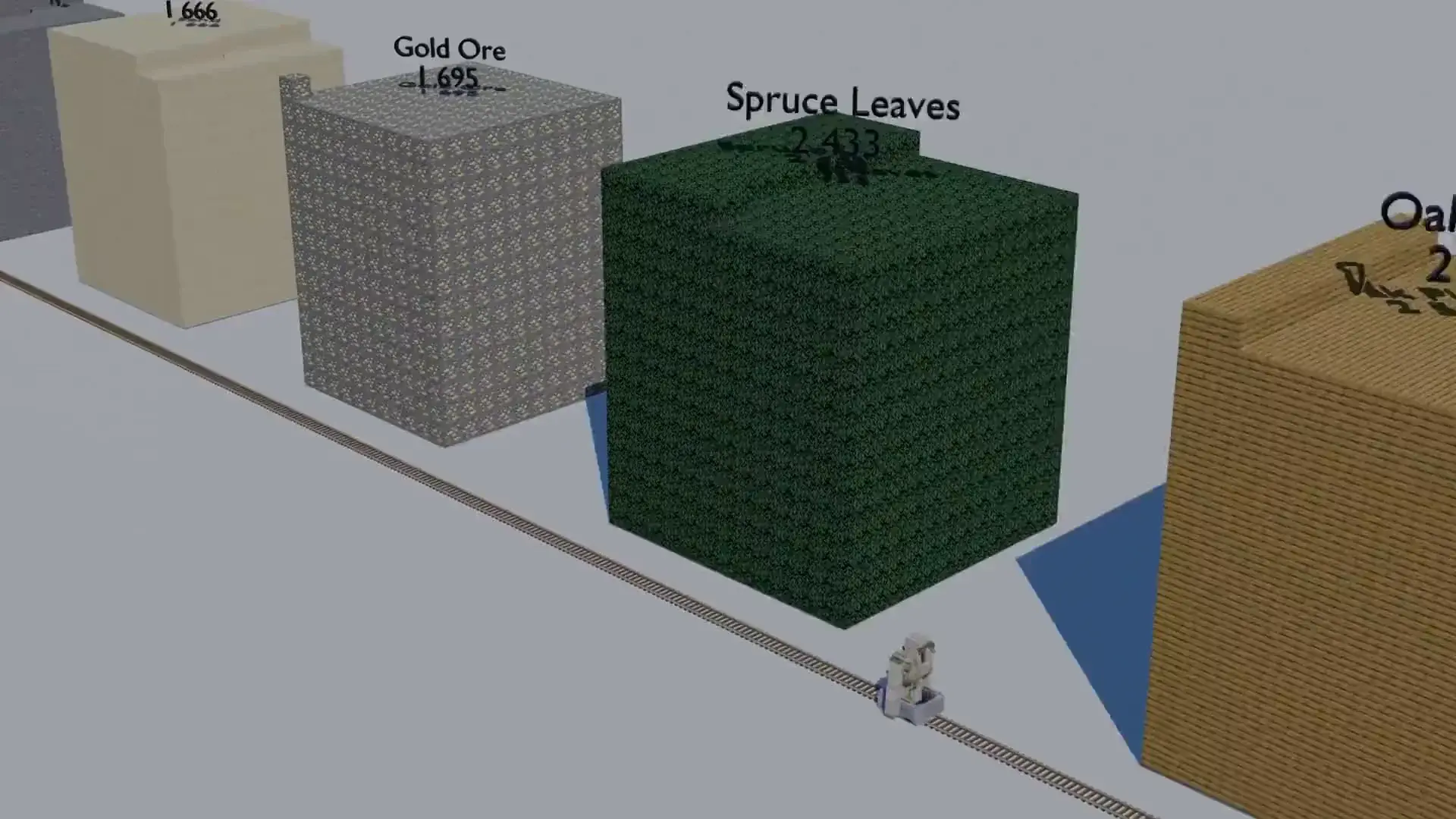
One Minecraft block is 1 meter wide, 1 meter tall, and 1 meter deep. That’s 3.28 feet, or about 39.4 inches, on every side. Mojang has confirmed this scale through both the official Player movement specs and the Minecraft Wiki, so it isn’t just a fan estimate.
The math becomes much more interesting once you start measuring the rest of the world against it. Steve isn’t 1 block tall. The Nether portal isn’t 4 blocks tall. A creeper isn’t even close to a player’s height. This guide walks through 30+ real measurements you can use the next time you want a structure to feel right at human scale.
Quick Reference Card
- 1 block = 1 m = 3.28 ft = 39.37 in
- Steve (player) = 1.8 m = 5 ft 11 in = 71 in
- Player width = 0.6 m = 1.97 ft = 23.6 in
- Creeper = 1.7 m tall = 5 ft 7 in
- Enderman = 2.9 m tall = 9 ft 6 in
- Iron Golem = 2.7 m tall = 8 ft 10 in
- Standard door = 2 blocks = 6 ft 7 in (real doors are 6 ft 8 in, so this is almost exact)
- Bed = 2 long × 1 wide = 6 ft 7 in × 3 ft 3 in
Why 1 Block Equals 1 Meter
The 1-meter figure comes from player movement physics. Steve falls at 9.78 m/s² in Minecraft, which is within rounding distance of Earth’s 9.81 m/s² gravity. His running speed (5.612 m/s) is faster than Usain Bolt’s average but consistent with the meter-per-block grid. The math only works cleanly if each block is exactly 1 cubic meter.
This also matches the in-game volume of water. A bucket holds one block of water, and one block of water displaces a real-world cubic meter (1,000 liters). Mojang stays consistent on this. Even the new bundles in 1.21 keep the same unit relationship.
The Player Model in Real Units
Steve and Alex are 1.8 m tall, 0.6 m wide, and 0.6 m deep when standing. The hitbox is a tight rectangular prism with a small head bonus that pokes above 1.8 m. The head itself is one full block wide (0.5 m or so on each face of the cube model, but the hitbox treats it as part of the upright body).
Crouching shrinks Steve to 1.5 m. Swimming and gliding shrink him to 0.6 m tall, 1.8 m long, oriented horizontally. That’s the only time the player model becomes wider than tall.
Mob Sizes: Real-World Comparison
| Mob | In-game height | Real-world equivalent |
| Chicken | 0.7 m | 2 ft 4 in (a real adult hen is about 1 ft 6 in, so chickens are oversized) |
| Pig | 0.9 m | 2 ft 11 in (close to a real pot-bellied pig) |
| Sheep | 1.3 m | 4 ft 3 in (a real sheep is 2 ft 6 in, so Minecraft sheep are nearly double size) |
| Cow | 1.4 m | 4 ft 7 in (real dairy cows are about 4 ft 9 in at the shoulder, so this is close) |
| Wolf | 0.85 m | 2 ft 9 in (a real grey wolf is about 2 ft 8 in at the shoulder) |
| Zombie / Husk | 1.95 m | 6 ft 5 in |
| Skeleton / Stray | 1.99 m | 6 ft 6 in |
| Creeper | 1.7 m | 5 ft 7 in |
| Spider | 0.9 m tall, 1.4 m wide | 2 ft 11 in tall, 4 ft 7 in wide (an actual giant huntsman spider is 1 ft wide) |
| Enderman | 2.9 m | 9 ft 6 in (taller than a residential ceiling) |
| Iron Golem | 2.7 m | 8 ft 10 in |
| Ravager | 2.2 m tall, 1.95 m wide | 7 ft 3 in tall, 6 ft 5 in wide |
| Ghast | 4 m × 4 m × 4 m | 13 ft cube (about the size of a one-car garage) |
| Warden | 2.9 m | 9 ft 6 in |
| Wither (boss) | 3.5 m tall, 0.9 m wide | 11 ft 6 in |
| Ender Dragon | 8 m long, 8 m wingspan | 26 ft cubed (smaller than fan estimates suggest) |
Builds That Match Real Buildings
If you want a house that feels lived-in instead of cramped, copy real residential dimensions. Most North American single-family homes use these:
- Ceiling height: 8 ft = 2.44 blocks. Round up to 3 blocks for breathing room.
- Standard bedroom: 10 ft × 12 ft = 3 × 4 blocks (tight, like a college dorm).
- Comfortable bedroom: 14 ft × 16 ft = 4 × 5 blocks.
- Two-car garage: 24 ft × 24 ft = 7 × 7 blocks (8 × 8 if you want walking room).
- Hallway width: 36 in = 0.9 m. Doesn’t fit. Minimum walkable hallway in Minecraft is 1 block wide, which is roughly 39 in (already exceeds real-world spec).
- Front door width: 36 in = 0.9 m. Vanilla doors are 1 block wide, so they sit at human scale already.
- Stair tread: 11 in deep. Minecraft stairs cover 1 block, so they overshoot real treads. Use slabs for a finer staircase.
When Mods Break the Block Scale
The 1-block-equals-1-meter rule breaks the moment you install mods that add custom models. Pixelmon’s larger Pokemon (Wailord, Steelix) span 5 to 7 blocks because their canonical Pokedex sizes demand it. Lycanites Mobs scales bosses past 4 blocks tall to make them visually intimidating in arenas. Even cosmetic mods like Custom NPCs let creators stretch character height to 2x or shrink it to 0.5x.
Modders also play with body proportions inside a single-block height envelope. The Jenny Mod character model gallery shows this well: every model keeps the standard 1.8 m player hitbox but rebuilds the actual mesh with hourglass proportions, wider hips, and detailed facial geometry. The block scale stays consistent, the visible model does not. It’s a useful visual reference if you want to see how far character detail can be pushed without breaking vanilla physics.
That distinction matters for builders. The hitbox is what the game uses for collision. The model is what you see. As long as the hitbox stays vanilla, your doorways and ceilings still work. Modded characters can have any silhouette you can fit into 0.6 m wide × 1.8 m tall.
Vehicles, Boats, Carts
- Boat: 1.4 m × 1.4 m × 0.5 m tall. Fits two seated players (or a player and one mob).
- Minecart: 0.98 m × 0.7 m. About the size of a real laundry basket.
- Horse: 1.6 m at the shoulder. Riding adds 1.5 blocks of clearance above. Mind your tunnel heights.
- Camel: 2.4 m at the hump with rider. Plan 4-block ceilings if you want camels indoors.
- Strider: 1.7 m + 2.1 m on top with rider. Total clearance needed: 4 blocks.
Famous Builds at True Scale
If you want to recreate real-world buildings, here’s what 1:1 actually means in block count:
| Building | Real height | Block count |
| Eiffel Tower | 330 m | 330 blocks (impossible to span vertically in a single chunk) |
| Statue of Liberty | 93 m | 93 blocks (fits in one chunk vertically with room to spare) |
| Big Ben (Elizabeth Tower) | 96 m | 96 blocks |
| Burj Khalifa | 828 m | 828 blocks (clips through the build limit on older versions) |
| White House | 21 m tall | 21 blocks |
| Average suburban home | 9 m | 9 blocks (3 stories at vanilla room height) |
Common Scale Mistakes to Avoid
Three traps catch most builders:
- Doors at 2 blocks but ceilings at 3. A real entryway has a transom or trim above the door. If your ceiling is right above your door header, the room feels squashed. Add 1 extra block of vertical space.
- Furniture too small. A vanilla bed is correctly sized for 1 player (0.9 m × 2.1 m). A two-block-wide table feels right for 4 chairs. Don’t shrink furniture to “save space” because Minecraft already shrinks rooms below real-world spec by default.
- Windows at floor level. Real window sills sit 0.9 m off the floor. In Minecraft, that’s 1 block above the floor, not flush with it.
Tools to Check Your Scale
- WorldEdit //size outputs the exact dimensions of any selection.
- F3 + I shows your facing direction and target block coordinates.
- Litematica lets you import 3D models built to scale outside the game (Blender, SketchUp) and overlay them as ghost blocks.
- Plotz (browser tool) calculates the right block radius for spheres, domes, and ellipsoids.
The Short Answer, One More Time
1 block = 1 meter, full stop. Build everything from that single unit and your worlds will read at the scale you actually live at. Stretch ceilings to 3 blocks, give bedrooms 5×5 minimum, and remember that the average mob is taller than you think (most are over 1.7 m, which is taller than the average human in 1900).
The blocky look hides it, but Minecraft is rendered at almost exactly human scale. Once you start measuring, you can’t stop seeing it.
Also Read

Add a Comment