
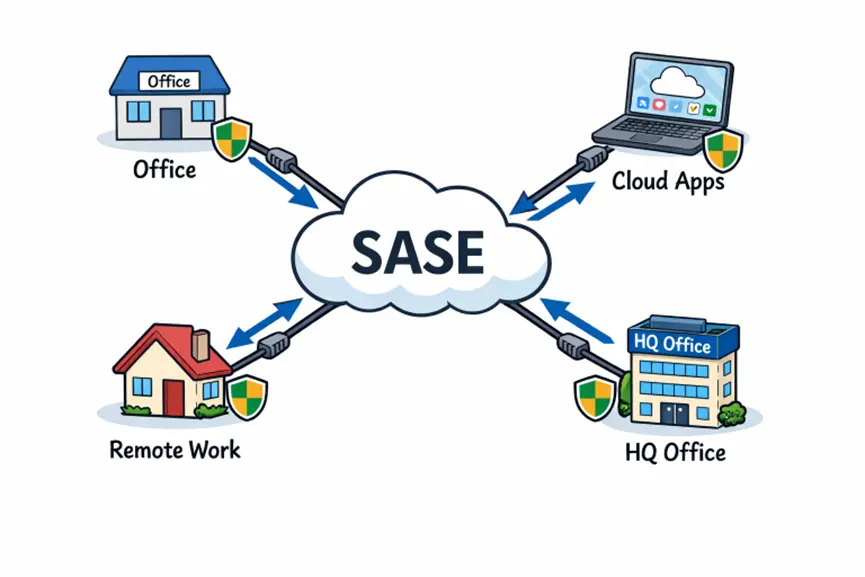
Modern enterprises are navigating an increasingly complex IT landscape marked by remote workforces, cloud applications, and expanding security risks. One transformative approach that addresses these challenges is Secure Access Service Edge (SASE), which seamlessly integrates networking and security in a scalable, cloud-delivered model. With secure access service edge solutions, organizations can provide robust protection while ensuring broad accessibility to applications and data for all users, regardless of their geographic location.
SASE represents a fundamental shift from traditional on-premises network and security models, which often create management silos and leave gaps that cyber threats can exploit. As more business processes move to the cloud, enterprises require a unified solution that can enforce security policies consistently and efficiently while connecting users to resources wherever they are.
Unlike legacy network architectures, SASE leverages the global reach of cloud platforms to deliver both connectivity and advanced security functions as a service. This means security enforcement is no longer tied to a centralized data center but distributed as close as possible to the user, which results in optimized performance and simplified scalability.
Organizations choosing a SASE approach gain agility in adapting to dynamic business demands. They can rapidly scale or adapt policies to match changing needs while keeping sensitive data protected from evolving threats. Enterprises that integrate SASE gain a competitive edge thanks to streamlined management and improved end-user experiences.
Key Components of SASE
- Software-Defined Wide Area Network (SD-WAN): SD-WAN intelligently routes traffic across multiple connections, ensuring applications receive optimal bandwidth and minimal latency. This flexible traffic management is essential for connecting remote users to cloud and on-premises resources efficiently.
- Security Service Edge (SSE): SSE encompasses crucial security capabilities, including Cloud Access Security Broker (CASB), Secure Web Gateway (SWG), and Zero Trust Network Access (ZTNA). CASB monitors cloud service usage and data transfers to prevent loss or unauthorized access, while SWGs protect users from web threats and enforce content policies. ZTNA moves beyond traditional perimeter security by verifying each user and device before granting application access, significantly reducing exposure to breaches.
Benefits of SASE
- Reduced Complexity: SASE unifies networking and security stacks, reducing the operational burden of managing multiple point solutions from different vendors and simplifying policy enforcement for IT teams.
- Enhanced Security: Organizations benefit from consistent security policies deployed across endpoints, offices, and cloud applications, regardless of user location. This uniform protection minimizes gaps that attackers could exploit.
- Improved Performance: SASE solutions direct user traffic through optimal routes, minimizing latency and improving application responsiveness. Distributed security inspection also accelerates access to critical services and reduces bottlenecks.
Challenges in Implementing SASE
- Integration with Existing Infrastructure: Migrating to SASE can be complicated, especially for enterprises with legacy systems. Full integration may require significant reengineering of networking and security architectures to avoid operational disruptions and ensure business continuity.
- Cost Considerations: While long-term operational efficiency and cost savings are substantial with SASE, initial deployment often demands considerable investment in both technology and change management.
- Skill Gaps: Successfully deploying and managing SASE solutions requires upskilling or reskilling IT teams. Organizations may need to invest in training or hire new talent as SASE demands proficiency in both cloud services and advanced security controls.
Steps to Implement SASE
- Assess Current Infrastructure: Map out existing network and security technologies, workflows, and user needs to identify gaps. This assessment provides a foundation for the transformative journey toward SASE.
- Define Security Policies: Work with business stakeholders to establish security policies that meet compliance, data governance, and operational requirements. Policies should remain adaptable as business needs and regulatory landscapes evolve.
- Select a SASE Provider: Evaluate vendors based on their ability to provide comprehensive, cloud-native solutions that match organizational priorities and offer strong customer support. Consider factors such as flexibility, reporting, and automation capabilities.
- Plan for Integration: Create a detailed migration plan covering pilot deployments, timeline, budget, and resource allocation. This plan should minimize disruption and support a phased rollout that incorporates user feedback and performance metrics.
- Implement and Monitor: Adopt a phased deployment strategy, continuously monitoring network and security performance. Use analytics to adjust configurations, ensure compliance, and troubleshoot emerging issues quickly.
Case Studies
Organizations across industries are realizing tangible gains from SASE implementation. For example, a recent industry report showed that digitally advanced companies leveraging SASE solutions achieved almost 7 percent cost savings and an 8 percent increase in overall revenue growth compared to their peers. These measurable gains come from increased operational efficiency and reduced security incidents, as reported by Cato Networks.
Future of SASE
The outlook for SASE adoption remains strong as enterprises accelerate cloud transformation and hybrid work environments become standard. Innovation in artificial intelligence and machine learning will enhance SASE platforms, enabling automated threat detection and adaptive policy enforcement. Integration with identity-centric models and increased use of behavioral analytics will drive even greater security and user experience improvements.
Conclusion
SASE delivers a strategic advantage for forward-thinking enterprises, breaking through the limitations of traditional IT architectures. By unifying networking and security in a cloud-delivered service, SASE empowers organizations to safeguard assets, streamline management, and deliver optimal performance to users everywhere. Careful evaluation, planning, and iterative rollout ensure the best outcomes as enterprises embrace this paradigm-defining technology.
Also Read

Add a Comment