Key Takeaways
- Bridge replacement planning should begin with the site, its users, and its operating constraints.
- Traffic control, rail coordination, environmental reviews, and equipment access all affect the construction schedule.
- Short closures require detailed sequencing, backup plans, and clear decision-making authority.
- Data, field verification, and public communication help teams manage risk before it becomes a delay.
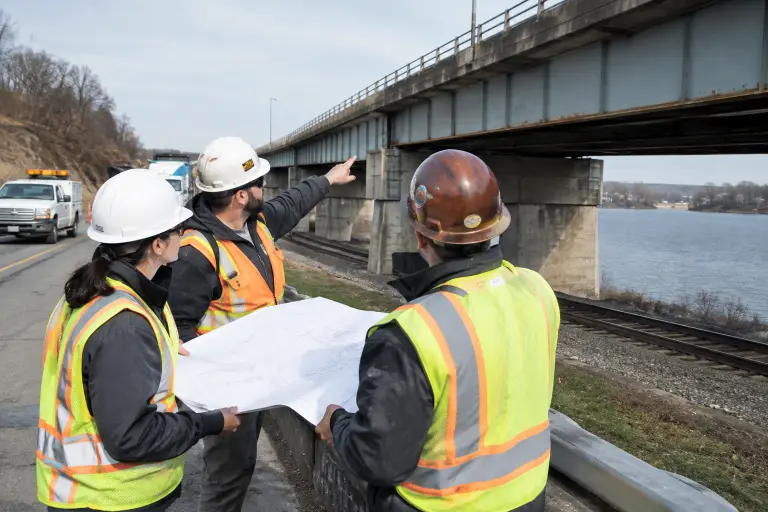
Bridge replacement is rarely just a structural project. It can affect motorists, rail operators, pedestrians, emergency responders, businesses, utilities, waterways, and nearby neighborhoods. Owners and project teams that need support with these overlapping demands can view more about work involving railroad and highway bridge environments.
In 2026, successful bridge work depends on making practical decisions before crews arrive on site. A sound plan connects engineering requirements to real-world constraints, including traffic volumes, rail movements, available staging space, permit conditions, weather, and the time required to safely reopen a route.
Why Bridge Planning Is More Complex Than It Appears
A bridge can carry far more than vehicles. It may support a highway over rail tracks, cross a creek, provide a pedestrian connection, or serve as a key freight route. Replacing or modifying that structure means protecting the people and systems around it while completing the work to the required standard.
Planning cannot be reduced to a start date and a completion date. The team must identify what can happen under normal operations, what requires a lane closure or rail outage, and what must wait for a specific weather, water-level, or permit window. The earlier those constraints are defined, the more realistic the schedule becomes.
Define the Problem Before Choosing the Method
The first question is not which machine or demolition method to use. It is what the project must accomplish. A bridge may need a full replacement because of structural condition, a deck replacement to address deterioration, a repair to a damaged element, improved load capacity, better drainage, or updated safety features.
A clear project definition gives owners a better basis for comparing repair, partial replacement, and complete replacement. It also keeps the design and construction teams focused on the intended outcome, rather than selecting a method before the site conditions and operational needs are understood.
Collect Site Information Early
Early field information prevents avoidable surprises. Teams should review available plans and inspection records, then confirm critical conditions in the field. Useful information includes utility locations, drainage paths, roadway and rail clearances, soil conditions, water levels, adjacent structures, access points, and feasible staging areas.
Equipment access deserves special attention. A lifting plan may look practical on drawings but fail if cranes cannot reach the work area, delivery vehicles cannot enter safely, or a narrow site leaves no room to store removed material. Mapping these limits early helps shape the construction sequence.
Build the Schedule Around Actual Work Windows
Short work windows are common near active roads and rail lines. A project may require a weekend closure, a nighttime outage, a low-traffic period, or a limited rail possession. The schedule should separate preparatory work from tasks that can only occur during the closure.
- List every required road closure, rail outage, inspection, and permit milestone.
- Identify work that can be completed before the shutdown, including staging, saw cutting, material delivery, and equipment testing.
- Assign durations for setup, removal, cleanup, and final inspection, not just the main construction activity.
- Establish recovery steps for rain, equipment failure, delayed deliveries, or unexpected site conditions.
Traffic planning should be part of this schedule from the beginning. The Federal Highway Administration defines work zone traffic management as the assessment of impacts and the documentation of strategies to reduce them in a transportation management plan. Those strategies can address delay, queues, emergency access, incidents, and communication with road users. Work zone traffic management is therefore a project-control function, not simply a sign-placement exercise.
Plan Traffic, Rail Operations, and Work Methods Together
Design a Detour People Can Actually Use
A detour must be understandable under real driving conditions. Project teams should consider peak travel times, school routes, freight activity, nearby events, pedestrian needs, and access for emergency services. Temporary signals, barriers, message boards, flaggers, lane shifts, and advance warning signs should function as a single coordinated system.
Before a major closure, it is helpful to test the route and confirm that signs are visible, turns are practical for larger vehicles, and local access is maintained. Traffic conditions should also be monitored after implementation so the plan can be adjusted if queues or safety concerns emerge.
Coordinate Early Near Active Rail Lines
Work near railroad tracks requires close coordination with the rail owner and operating personnel. Construction teams need clear procedures for worker access, equipment limits, track protection, outage requests, communications, and return-to-service checks. The Federal Railroad Administration notes that track clearances near structures are generally prescribed by states or other agencies, which reinforces the need to confirm project-specific requirements rather than rely on assumptions. Track clearance requirements should be verified during planning and before field operations begin.
Method selection should also fit the setting. Controlled cutting, drilling, lifting, dismantling, and conventional demolition each have different implications for vibration, noise, debris, access, and removal sequence. Near active traffic, rail lines, utilities, historic structures, or water, lower-impact methods may offer better control when supported by the site conditions and engineering plan.
Address Environmental Reviews and Safety Before Mobilization
Environmental requirements can influence both design and construction timing. Teams should identify waterways, wetlands, floodplains, protected habitat, public access areas, and historic resources early. Permit conditions may require containment, inspection records, restricted work periods, erosion-control measures, or specific cleanup procedures.
For short outages, the safety plan should be especially direct. Assign one person to control the outage timeline. Conduct a pre-task meeting before major work begins. Verify lifting points, access systems, cutting tools, barriers, communication equipment, and backup equipment. Every worker should understand the stop-work rules and know who can decide to pause operations.
Use Data and Communication to Control Risk
Daily records help project teams see trouble early. Useful items to track include production rates, closure hours, weather, equipment use, inspection results, traffic delays, photos, and unresolved field issues. Shared schedules and digital checklists can make those records easier to review across owners, engineers, contractors, and inspectors.
Public communication should be plain and timely. People need to know what is changing, when the change begins, how long it is expected to last, and which route to use instead. If the schedule changes, the update should be issued quickly through the channels people are most likely to see.
Common Planning Mistakes to Avoid
- Confirming road or rail closures too late.
- Ignoring equipment access and staging until construction starts.
- Leaving permits and environmental restrictions outside the master schedule.
- Underestimating setup, testing, cleanup, and final inspection time.
- Relying on one critical piece of equipment without a contingency plan.
- Using a detour that works on paper but creates confusion or unsafe conditions in practice.
- Failing to define stop-work authority when conditions change.
Conclusion
Difficult bridge work becomes more predictable when planning starts with actual site conditions and operating constraints. By integrating structural needs, traffic control, rail coordination, environmental care, equipment access, safety procedures, and public updates into a single working plan, project teams can reduce surprises and protect the transportation routes that communities depend on.
Also Read

Add a Comment