
Table Of Contents
- Why More Than One Option May Exist
- How Dentists Decide Which Restoration Fits
- Inlays, Onlays, And Overlays
- Composite Bonding And Larger Fillings
- When Veneers May Be A Cosmetic Choice
- Where Endocrowns May Fit
- Options For Replacing A Missing Tooth
- When Full Coverage May Still Be The Safer Choice
- A Simple Way To Compare Options
- Questions To Ask Before Treatment
- Final Takeaway
A damaged tooth does not automatically need a full-coverage restoration. Depending on the location and extent of the problem, patients may have several dental crown alternatives to discuss with their dentist. The goal is not to choose the smallest treatment in every situation, but to select an option that protects the tooth while preserving healthy structure whenever possible.
Fillings, bonding, inlays, onlays, veneers, endocrowns, and full-coverage restorations all serve different purposes. A treatment that works well for a small cavity or chipped front tooth may not provide enough strength for a cracked molar that absorbs heavy chewing pressure every day.
Why More Than One Option May Exist
Teeth can be damaged by decay, old fillings, wear, trauma, or cracks. Some problems are limited to a small area, while others affect the tooth’s ability to withstand normal bite forces. Preserving sound enamel and dentin can be valuable because every restoration may need repair or replacement eventually.
A thorough evaluation from North Orange Family Dentistry can help distinguish a cosmetic concern from a structural problem, or identify when both are present. X-rays, bite evaluation, visual examination, and sometimes crack-testing techniques can help guide the conversation.
How Dentists Decide Which Restoration Fits
Restorative planning is highly individual. Dentists commonly consider how much healthy tooth remains, whether decay or a fracture is present, the tooth’s position, and the amount of pressure it receives during chewing. Back teeth generally need to handle more force than front teeth, while a visible front tooth may require additional attention to shade and shape.
Other important factors include whether the tooth has received root canal treatment, the health of the gums, cavity risk, oral hygiene habits, and nighttime grinding. Timing, comfort, appearance, insurance, and budget matter too, but they should be weighed alongside the need for long-term protection.
Inlays, Onlays, And Overlays
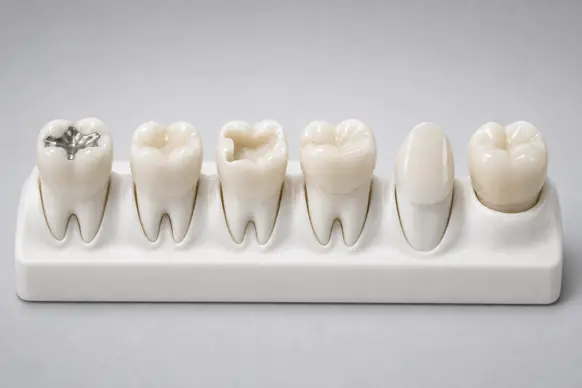
Partial coverage restorations can bridge the gap between a standard filling and complete coverage. These materials may include veneers, inlays, and onlays, with advantages and limitations that depend on the clinical situation.
- Inlays fit within the grooves of a back tooth and do not cover the pointed chewing surfaces, called cusps.
- Onlays extend over one or more weakened cusps to provide added support.
- Overlays cover most or all of the chewing surface while retaining some of the tooth’s outer walls.
These options may suit a tooth with damage too large for a routine filling but with enough stable structure to avoid complete coverage. They require careful preparation, dependable bonding, and a bite that will not overload the restoration. They are less suitable when a tooth has an extensive fracture, deep decay, or very little sound structure remaining.
Composite Bonding And Larger Fillings
Composite bonding uses tooth-colored resin applied directly to the tooth, often in one visit. It can be useful for small chips, minor edge wear, small cavities, and limited cosmetic changes such as short gaps or uneven front teeth. A larger composite filling may also restore a moderate area of decay.
These approaches are conservative, but they do not make a severely weakened tooth strong again. Composite can chip, wear, stain, or leak at its edges over time. Avoiding ice and hard objects, using a night guard when grinding is present, and keeping regular checkups can help protect the repair.
When Veneers May Be A Cosmetic Choice
Veneers are thin coverings bonded to the visible front surface of a tooth. They may improve persistent discoloration, small chips, minor shape differences, and spaces between front teeth. Porcelain veneers often provide a highly lifelike appearance and resist staining well, while composite veneers can be more readily repaired and may require less extensive preparation in selected cases.
However, veneers are primarily cosmetic restorations. They are not intended to replace the structural support needed when a tooth is heavily broken down, deeply cracked, or missing substantial tooth material on several surfaces.
Where Endocrowns May Fit
An endocrown may be considered for certain teeth that have had root canal treatment. It is designed to use the internal chamber of the tooth for retention rather than relying on a separate post in some cases. Whether it is appropriate depends on the remaining tooth walls, tooth shape, bite forces, location in the mouth, and ability to create a reliable adhesive seal.
Endocrowns are not a universal substitute for conventional full coverage. Teeth with weak remaining walls, extensive fractures, or challenging bite conditions may need another approach.
Options For Replacing A Missing Tooth
Replacing a missing tooth is different from repairing one that remains. Common choices include dental implants, fixed bridges, removable partial dentures, and, in selected cases, fiber-reinforced bridges. Bone volume, gum health, neighboring teeth, appearance goals, treatment time, cost, and maintenance requirements all affect the decision.
When Full Coverage May Still Be The Safer Choice
Full coverage can be the more protective choice when large portions of a tooth are missing, a crack extends across multiple surfaces, walls are thin and unsupported, or severe decay has reduced stability. It may also be appropriate after extensive treatment, repeated failure of a large filling, or when heavy grinding places intense pressure on the tooth.
Delaying treatment for a tooth that truly needs protection can allow a crack, cavity, or bite problem to worsen. The best choice is not necessarily the least treatment today. It is the treatment that gives the tooth a realistic chance to function comfortably over time.
A Simple Way To Compare Options
Materials also influence treatment planning. The American Dental Association explains that indirect restorative materials vary in strength, appearance, fabrication method, and clinical indication.
- Filling: Often used for small to moderate cavities. It is direct and conservative, but may not support a badly weakened tooth.
- Bonding: Often used for small chips and cosmetic changes. It is tooth-colored and efficient, but can stain or chip.
- Inlay: Often used for damage contained within the cusps. It restores a larger area while preserving outer walls.
- Onlay: Often used for weakened cusps. It adds support without covering every tooth surface.
- Veneer: Often used for front-tooth appearance concerns. It improves color and shape but does not provide major structural reinforcement.
- Full coverage: Often used for severe structural damage. It surrounds the remaining tooth but requires more preparation than partial options.
Questions To Ask Before Treatment
- How much healthy tooth structure remains?
- Is the issue cosmetic, structural, or both?
- Is there a crack, and how far does it extend?
- Would a filling, bonding, inlay, or onlay provide enough support?
- What could happen if treatment is delayed?
- How will this option perform with chewing or grinding?
- Can the restoration be repaired, and what maintenance will it need?
- How many visits are needed, and what might insurance cover?
Final Takeaway
A dental crown is a valuable restorative tool, but it is not the only option. The right solution depends on the condition of the tooth, the amount of healthy structure left, bite forces, cosmetic goals, and long-term needs. A careful examination can help identify the treatment that balances conservation, strength, function, and appearance.
Also Read-The Impact of Professional Cleaning on Workplace Health and Productivity

Add a Comment