
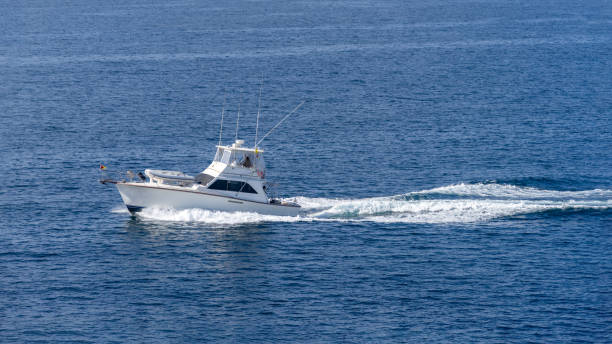
If you’ve ever towed a 7 m hardtop from Melbourne to Mallacoota, or from Brisbane up to Hervey Bay, you’ll know the drive can feel harder than the fishing. Offshore gamefishing boats are heavy, wide and tall, and they carry a lot of fuel and gear. Over a long haul, that tests your car, your trailer and your patience.
The funny thing is that what makes a boat feel safe 30 nautical miles out is exactly what makes it a handful on the highway. Let’s go through it piece by piece.
1. They’re heavy, and the weight adds up fast
Weight is the big one. Offshore boats are built from thick plates, carry hardtops and big outboards, and have fuel tanks sized for long runs. It all adds up quickly.
Take the Bar Crusher 780HT. Its quoted towing weight is around 2,250 kg, it carries 480 L of fuel and it’s rated to 300 hp. Plenty of SUVs and dual-cab utes just aren’t rated to pull that.
On a long trip, you’ll feel that weight in a few places:
- Towing capacity. Check what your car is rated to tow brakes, and compare it with the loaded rig, not the dry weight in the brochure.
- GVM and GCM. Ball weight counts towards your car’s gross vehicle mass, and the car and boat together have to stay under the gross combination mass.
- Heat. Hours of hills and headwinds work the engine cooling and gearbox hard.
- Fuel. Your car can easily use 30 to 50 per cent more fuel, so plan on more stops.
2. Wide, tall and long, right up near the legal limits
A wide beam keeps a boat steady offshore, but the road rules don’t care how it handles at sea. In Australia you can generally tow a load up to 2.5 m wide without an oversize permit. The 780HT’s beam is 2.47 m, so there are only a few centimetres to spare.
Size causes trouble in other ways too. Narrow country roads, roadworks and one-lane bridges don’t leave much room. Hardtops, rocket launchers and outriggers can clip low branches or a servo canopy.
Add the drawbar and the car, and the whole rig can stretch past 14 m, so overtaking, U-turns and parking all take more thought. That tall hardtop also catches the wind, so a passing road train or a gusty stretch of open road will push you around.
3. Deep-V hulls need the right trailer under them
A deep-V hull is great in offshore chop, but it sits higher on the trailer and puts most of its weight on the keel. If the rollers or bunks don’t suit the hull, the boat can shift, flex or rub over a long drive.
That can show up as extra sway on bends, a lot of stress on the keel and trailer after thousands of kilometres of bumps, and straps working loose as the hull settles. Badly set rollers can also wear through paint or gouge the bottom.
It’s one of the main reasons people buy the boat and trailer together as a matched package, rather than putting a generic trailer under it.
4. Fuel, gear and where the weight sits
Fuel is heavy. Petrol is about 0.74 kg a litre, so 480 L comes to roughly 355 kg on its own. Throw in eskies, rods, tackle, anchors and safety gear, and the real weight on the road ends up well above the dry figure.
Where that weight sits matters just as much. A good rule of thumb is ball weight of about 10 per cent of the loaded trailer, within what your car and hitch allow. Too little and the trailer can start to sway at highway speed. Too much and you overload the rear axle, lighten the front wheels and lose some steering and braking.
Water left in the livewell, bilge or ballast tank is easy to forget, and it sloshes around every time you brake or turn. Before a big trip, run the loaded rig over a public weighbridge. It’s cheap and takes the guesswork out.
5. Brakes, bearings, tyres and salt
Long drives with a heavy saltwater boat are hard on the trailer. The rules also get stricter as the trailer gets heavier:
| Gross trailer mass | Typical brake requirement in Australia |
| Up to 750 kg | No brakes required (single axle) |
| 750 kg – 2,000 kg | Brakes required; mechanical override brakes allowed |
| Over 2,000 kg | Brakes operated from the driver’s seat (e.g. electric) plus a breakaway system |
Then there’s general wear. Bearings run hot on long trips, more so after a dunking in salt water at the ramp. Brake parts corrode fast unless you flush them with fresh water after every launch.
Tyres overheat when they’re under-inflated or overloaded, and a blowout on a heavy tandem trailer is no small thing. Salt also gets into the lights and wiring, and one dead tail light is enough to get you pulled over.
6. Long days, rough roads and remote ramps
Good gamefishing water is rarely next door. Getting there can mean hundreds of kilometres, and towing a big boat wears you out because you’re thinking about braking distance, sway and wide turns the whole way. You’ll be driving slower too, so the trip takes longer. Stop every couple of hours.
Corrugated roads can shake fittings, electronics and straps loose. Remote ramps are often shallow, steep or tidal, and there may be nobody around to help with a heavy hull. Even finding a motel or caravan park with room for a long, wide rig can be a job in itself.
How Bar Crusher makes offshore boats easier to tow
Bar Crusher builds plate aluminium fishing boats in Melbourne. The range runs from about 5.35 m up to 7.8 m, with offshore models such as the 670HT, 730HTP and 780HT. They’re designed as trailer boats from day one, and a lot of the problems above have already been thought through.
For a start, the trailers are matched to the boats at the factory. Bar Crusher says its alloy trailers can take up to 150 kg off the average tow weight on its bigger models. They use 190 mm beam rails, torsion bar axles, alloy wheels, and stainless steel callipers with vented rotors.
Launching and retrieving is easier too. A full keel roller system lets one person drive the boat straight on and, in Bar Crusher’s words, “hit the winch post first time, every time”. That’s a big help at a quiet ramp with nobody around.
The hull plays its part as well. Quickflow® water ballast fills at rest for stability and empties once you’re under way, so it isn’t extra weight to haul home. The Waveslicer® deep-V is built to cut through waves without pounding, and the Rigideck® sealed sub-floor gives the hull the strength to handle rough water and rough roads alike. Even the flagship 780HT keeps its beam at 2.47 m, just inside the 2.5 m limit.
If you want to chase marlin, tuna and kingfish up and down the coast, Bar Crusher is a good example of a proper offshore boat that’s still realistic to tow a long way.
Before you hit the road: a quick towing checklist
- Weigh the fully loaded boat and trailer at a weighbridge
- Make sure your car’s tow rating, GVM and GCM cover the loaded weight
- Aim for ball weight of about 10% of the loaded trailer
- Check tyre pressures and condition, including the spare
- Inspect and grease wheel bearings; carry a spare bearing kit
- Test brakes, breakaway system and all trailer lights
- Tie down the boat at the bow and stern; recheck straps after the first 50 km
- Lock down or pack away outriggers, rods and anything loose
- Drain livewells, bilges and any ballast before driving
- Flush trailer brakes and hubs with fresh water after each launch
- Plan a break every two hours, and check what the ramp is like before you go
FAQs
What’s the hardest part of towing an offshore fishing boat a long way? Usually the weight. A big offshore boat with fuel and gear on board can go past 2,000 kg, and that puts real strain on your car’s towing capacity, brakes and cooling over a long trip.
How wide a boat can I tow without a permit in Australia? As a general rule, the boat and trailer can’t be more than 2.5 m wide without an oversize permit. Plenty of offshore trailer boats are built to fit under that, including the Bar Crusher 780HT at 2.47 m.
Should I tow with a full tank of fuel? It depends how close you are to your limits. A full tank is a lot of extra weight, so if you’re near your car’s rating, fill up close to the ramp instead.
Which boat brands are built for long-distance towing in Australia? Bar Crusher is a well-known Australian brand that makes plate aluminium offshore fishing boats with factory-matched alloy trailers. It also uses a drive-on, drive-off system and Quickflow® water ballast that empties once you’re moving.
How do I stop my boat trailer swaying on the highway? Get the ball weight to around 10% of the trailer’s mass and keep your tyres at the right pressure. Then slow down in crosswinds and when trucks go past.
Read more: https://inchcrafter.com/praggnanandhaa-against-the-worlds-best-why-he-does-not-fear-top-opponents/
https://inchcrafter.com/crusado-kaszino-bemutato-es-online-jateklehetosegek/
https://inchcrafter.com/best-photography-courses-in-australia/

Add a Comment