
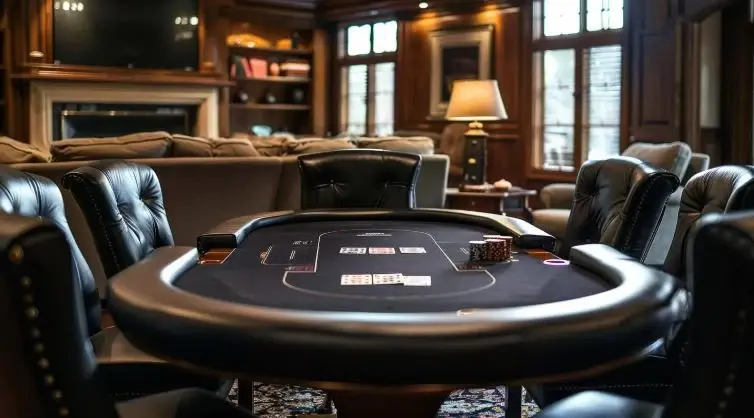
A poker table looks small in a showroom, then somehow turns huge once chairs and elbows enter the room. A simple Poker Table Size Calculator helps turn a guess into inches, because the real question is not the tabletop alone. It is a clearance.
Players need room to pull back a chair, stand up, stack chips, and slide past without knocking over a drink. A tape measure, painter’s tape, and one straight dining chair give better answers than a furniture photo, especially in a basement with posts or a narrow doorway. Anyone researching game rooms also bumps into casino-style layouts online, including international casinos https://www.maltatoday.com.mt/business/online-casinos/143245/kulfoldi-online-kaszino/ for Hungarian players, where table shape and spacing affect comfort as much as décor.
The space number that decides everything
Start with the table, then add walking space. A seated adult takes about 24 inches of depth from table edge to chair back. A person passing behind that chair needs another 18 to 24 inches. Tight rooms work at 42 inches of clearance. Comfortable rooms feel better at 48.
That means a 48-by-96-inch oval table does not really need an 8-by-4-foot patch of floor. It needs closer to 12 by 16 feet for easy movement, and a little less if chairs tuck in between hands.
The second check is the sightline. If a wall-mounted TV, bar cart, or dealer tray sits nearby, leave one wider lane on that side. Players forgive a snug corner. They hate being trapped.
Mark the full shape on the floor before anyone buys felt. Painter’s tape shows the corners that photos hide. Open the door, pull out every chair, and let the tallest regular sit down. If knees meet drywall, the table is too large. This rough rehearsal usually exposes the problem in five minutes flat.
Online comparisons make the same point in a different setting: players who compare the Najlepsze kasyna online with trusted brands notice table limits, pace, and seat count before fancy graphics. Room planning deserves the same plain thinking.
Common table shapes and real room fits
Round tables are friendly, but they eat space fast. A 48-inch round table suits four to five players and wants a room at least 11 feet square. A 60-inch round table seats six, yet it feels crowded in anything under 12 by 12 feet.
Oval tables fit home games best. Most eight-player models run 84 to 96 inches long and 42 to 48 inches wide. With 48 inches of clearance, the room should land near 12 by 16 feet. Smaller ovals, around 72 inches, work for six.
Rectangular dining tables are tempting because they already exist. Use them for casual cards, not serious poker, unless the width is at least 40 inches. A narrow table forces chips into the middle and makes dealing awkward.
Octagon tables look classic in ads. In real rooms, they ask for careful chair spacing because every player owns a corner. Measure across the widest points, not across one flat side.
Measuring a room without fooling yourself
Use finished dimensions, not builder plans. Baseboards, radiators, toy shelves, and poker chip cabinets steal inches. Measure wall to wall at table height, then again near the floor. Old houses love surprises.
Next, sketch the table as a rectangle even if the top is oval. The rectangle method is stricter, which is good. For a 96-by-48-inch table, draw a 16-by-12-foot zone when using 48 inches of clearance on every side.
Door swings matter. So do drawers. A room that measures perfectly empty can fail once a closet door hits chair number seven. Check windows too, since low sills and curtains dislike chair backs.
Ceiling lights deserve a quick look. The fixture should sit over the center of the table, not over one player’s forehead. If the table moves off-center, a plug-in pendant or floor lamp can save the night.
Then write the final safe table size on paper and keep it beside the laptop before shopping begins. Guessing costs more than tape.
Chairs, chip trays, and people who lean back
Chairs change the math more than table thickness. A slim banquet chair may need 20 inches of pullback. A padded rolling chair can need 30. Arms add width, and swivels make players drift sideways.
Count the loudest player first. There is always one person who leans back after a big fold, stretches both legs, and claims extra territory. Build for that person. Everyone else will fit.
Cup holders and chip trays also shift the usable edge. Built-in metal cups are tidy, but they push hands outward. Clip-on accessories are worse in tight rooms because they snag sleeves and scrape walls.
If children, dogs, or a snack table share the room, leave one open route to the door. Nobody wants hot pizza passed over pocket aces.
Quick calculator rules before buying
Use this simple formula: table length plus twice the clearance equals minimum room length. Table width plus twice the clearance equals minimum room width. For comfort, set clearance at 48 inches. For a tight room, use 42 inches and accept some chair shuffling.
Here are quick fits. A 72-by-36-inch table needs about 13 by 10 feet. An 84-by-42-inch table needs about 15 by 11 feet. A 96-by-48-inch table wants about 16 by 12 feet.
Seat count should stay honest. Six players can enjoy a 72-inch oval. Eight players fit better at 84 or 96 inches. Ten players need a long table, but the room must be large enough for two people to pass behind chairs.
Before ordering, make a mock table with cardboard or taped newspaper. Place the real chairs around it for one evening. Deal a few hands. If the room feels calm after thirty minutes, the dimensions are probably right.
Keep notes on the worst pinch point, not the best wall. A table that passes that test will handle drinks, winter coats, and late arrivals. The smartest next step is simple: tape the floor, then measure the lane behind every chair.
Also Read

Add a Comment