
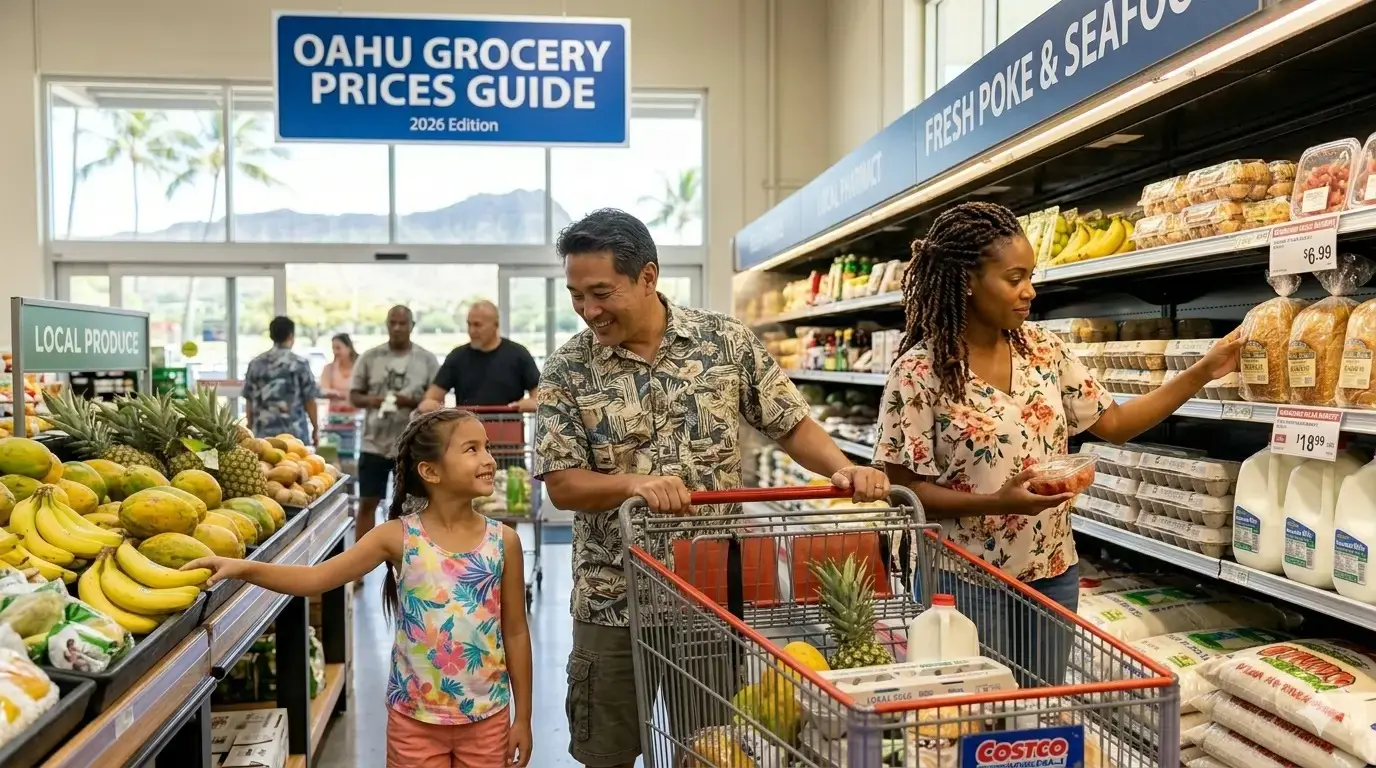
Everyone will warn you about the high food costs. It is true that Hawaii is one of the most expensive places for groceries. You might wonder, how much is a loaf of bread in hawaii or why milk is so pricey? After months of analyzing local markets, I found that you don’t have to spend a fortune. If you know the “local secrets,” you can shop smart and save big.
In this comprehensive guide, we will break down the actual costs you will see on the shelves this year and how to navigate the grocery aisles of Oahu like a pro.
Oahu Grocery Prices 2026: What to Expect at the Checkout
Hawaii’s isolation is the main reason for high costs. Nearly everything you eat on Oahu travels thousands of miles across the ocean. When you shop today, you pay for fuel, shipping, and labor—not just the food. This is why hawaii grocery prices 2026 remain high, as getting goods to the middle of the Pacific is a massive logistical task.
On average, grocery prices on Oahu are 30% to 50% higher than in cities like Las Vegas or Dallas. A basic bag of groceries that might cost $50 on the mainland will likely hit $75 to $85 here. For a family of four, a weekly grocery bill of $500 is now considered “normal” for those who shop without a strategy.
Average Cost of Essential Groceries in Honolulu
To give you a clear picture, let’s look at the current 2026 price points for the items that end up in almost everyone’s cart.
Staple Items Price List (Milk, Bread, & Eggs)
The prices of staples have seen a slight increase due to higher production costs on the mainland.
- Gallon of Milk: Expect to pay between $6.99 and $9.89. The price varies wildly depending on the store. Costco offers the lowest price, while smaller neighborhood markets are at the higher end.
- Loaf of Bread: A standard loaf of white or wheat bread costs between $5.50 and $7.50. Artisanal or organic loaves can easily reach $10.
- Dozen Eggs: Regular large eggs are currently $6.50 to $8.00. If you prefer pasture-raised or local Hawaii eggs, be prepared to pay $11.00 per dozen.
- Butter (1lb): Currently averaging $7.00.
- Cereal: A standard box of brand-name cereal is roughly $7.50 to $9.00.
Meat and Seafood Costs: From Chicken to Fresh Poke
Protein is often the most expensive part of the bill.
- Chicken Breast: Boneless, skinless chicken is about $5.99 – $7.99 per pound.
- Ground Beef: Standard 80/20 beef is $7.50 per pound, while organic grass-fed beef hits $10.50.
- Fresh Ahi Poke: This is a Hawaii staple. In 2026, fresh (not frozen) Ahi Poke at the deli counter costs between $19.99 and $26.00 per pound depending on the grade and seasonings.
- Local Fish: Prices for Mahi-Mahi or Ono fluctuate based on the daily catch but expect $22.00+ per pound.
Why are Groceries so Expensive in Hawaii? (The 2026 Reality)
Many visitors ask, “Why is a bag of chips $8?” The answer lies in the “Jones Act” and logistics.
- The Jones Act: This federal law requires that all goods shipped between U.S. ports be carried on ships built, owned, and operated by United States citizens. This limits competition and keeps shipping rates high.
- Matson & Pasha: These are the two main shipping lines. Every time fuel prices rise, they add a “fuel surcharge” which is immediately added to the price of your milk and eggs.
- Land & Electricity: Hawaii has the highest electricity rates in the U.S. Grocery stores have to run massive refrigeration units 24/7 in a tropical climate, which adds huge overhead costs.
Top 5 Cheapest Grocery Stores in Oahu for Budget Travelers
If you want to save money, you have to be selective about where you shop. Here are the top 5 budget-friendly spots in 2026:
- Costco (Iwilei, Hawaii Kai, Waipio, Kapolei): The absolute best for bulk. The Iwilei location is the busiest in the world for a reason—it saves you the most money.
- Target: Surprisingly, Target has kept its grocery prices very competitive, especially for dry goods and snacks.
- Walmart: Ideal for toiletries, canned goods, and frozen items.
- Don Quijote: A Japanese discount giant. It’s the best place for produce, unique snacks, and affordable pre-made “Bento” boxes.
- Sams Club: A great alternative to Costco with similar bulk savings.
Costco Iwilei vs. Foodland: Where Should You Shop?
This is the ultimate showdown for Oahu shoppers. Costco is for the “Big Haul.” If you are staying for more than 4 days, go here first. Their rotisserie chicken is still a legendary $4.99 even in 2026—this is the cheapest hot meal on the island.
Foodland is for the “Experience and Quality.” It is a local chain. While more expensive than Costco, their produce is often fresher, and their Poke department is world-class. If you just need a few items for dinner, Foodland is more convenient, but your bill will be 20% higher.
How to Save Money on Food While Staying in Waikiki
Most tourists stay in Waikiki, which is the most expensive “food desert” on the island.
Avoiding the “Tourist Tax” at ABC Stores
ABC Stores are convenient, but they are not grocery stores. Buying a full meal’s worth of ingredients here will cost you double. Use ABC stores for emergency water or a single snack, but for real shopping, take a 10-minute Uber to the Safeway on Kapahulu Avenue or the Whole Foods in Kaka’ako.
Utilizing Safeway and Foodland Rewards Cards
In 2026, stores have moved to digital-first rewards. Never shop without a loyalty card.
- Safeway Club Card: Can save you $3 on a single gallon of milk.
- Maika’i Card (Foodland): Gives you “Maika’i points” which can be used for discounts or even free airline miles (Hawaiian Airlines). Just give the cashier your phone number at checkout.
Shopping Local: A Guide to Oahu Farmers’ Markets
For fresh fruits and vegetables, skip the supermarkets.
- KCC Farmers Market (Saturdays): Located near Diamond Head. It’s a bit touristy, but the quality of local greens and honey is unmatched.
- Blaisdell Farmers Market (Wednesdays): This is where the locals go. You can find apple bananas, papayas, and avocados for much less than store prices.
- Farm Stands on the North Shore: If you drive up to Haleiwa, stop at the roadside stands. They often sell “Sunrise Papayas” 3 for $5—a steal in 2026.
Monthly Grocery Budget for Locals vs. Visitors
How much should you set aside?
- Visitors (Family of 4): If you eat breakfast and dinner at your rental and pack lunches for the beach, budget $600 per week.
- Locals (Single Person): A thrifty local can get by on $450 – $550 per month by shopping exclusively at Costco and Farmers Markets.
- The “Mainland Standard” Comparison: If you spend $800 a month on groceries in California, expect to spend $1,200 for the same lifestyle on Oahu.
Best Value Grocery Items to Buy in Bulk
To maximize your dollar, focus on these “High-Value” bulk items:
- Rice: A 20lb bag of Hinode or Diamond G rice is a staple in Hawaii homes.
- Spam: It’s a local favorite. Buying a 6-pack at Costco is significantly cheaper than buying single cans.
- Frozen Vegetables: Fresh produce spoils fast in Hawaii’s humidity. Frozen bags are a great way to avoid waste.
- Cases of Water/Sparkling Water: Individual bottles in Waikiki are $3. A case of 24 at Costco is around $7.
The Impact of 2026 Inflation on Local Goods
While imported goods are expensive, 2026 has seen a push for “Sustainable Hawaii.” More local farms are producing beef and dairy. Interestingly, some local grass-fed beef is now priced similarly to imported mainland beef because it doesn’t have the high shipping cost attached to it. Always check the labels for the “Hawaii Seal of Quality.”
Hidden Fees: The “Hidden” Costs of Shopping
When calculating your budget, don’t forget:
- Bag Fees: Oahu is plastic-free. If you don’t bring a reusable bag, you will pay 15 cents per paper bag. It adds up!
- The HI-5 Program: You pay a 5-cent deposit on every beverage container. You can get this back by taking your recycling to a “Reynolds” center, but most tourists end up donating this to the local trash bins.
Smart Shopping: The “Generic Brand” Strategy
In 2026, generic brands like Kirkland Signature (Costco), 365 (Whole Foods), and Signature Select (Safeway) have improved in quality. Switching from name-brand cereal or peanut butter to the store brand can save you an average of $2.00 per item. Across a full cart, that’s $40 in savings.
Grocery Apps and Digital Coupons
Before you go to the store, download the Safeway and Target apps. In 2026, the best deals are “Digital Only.” You “clip” the coupon in the app, and it applies automatically at the register.
Summary of Savings Tips for 2026
- Shop Bulk Early: Hit Costco on your first day.
- Eat Local Fruits: Papayas and bananas are cheaper than imported apples and grapes.
- Drink Tap Water: Oahu’s water is filtered through volcanic rock and is some of the best in the world. Skip the bottled water!
- Use the Apps: Digital coupons are your best friend.
By following this guide, you can enjoy the beauty of Oahu without the constant stress of your bank account balance. Hawaii is expensive, but with a little “Aloha Spirit” and a lot of smart shopping, it is manageable.
Final Verdict: Is Cooking at Home Still Cheaper in Oahu?
Even with high prices, cooking is still your best financial move. A casual dinner at a restaurant for two people will cost $70 without drinks. You can buy a pack of steaks, local corn, and a bag of salad for $40 and feed the whole family.

Add a Comment