
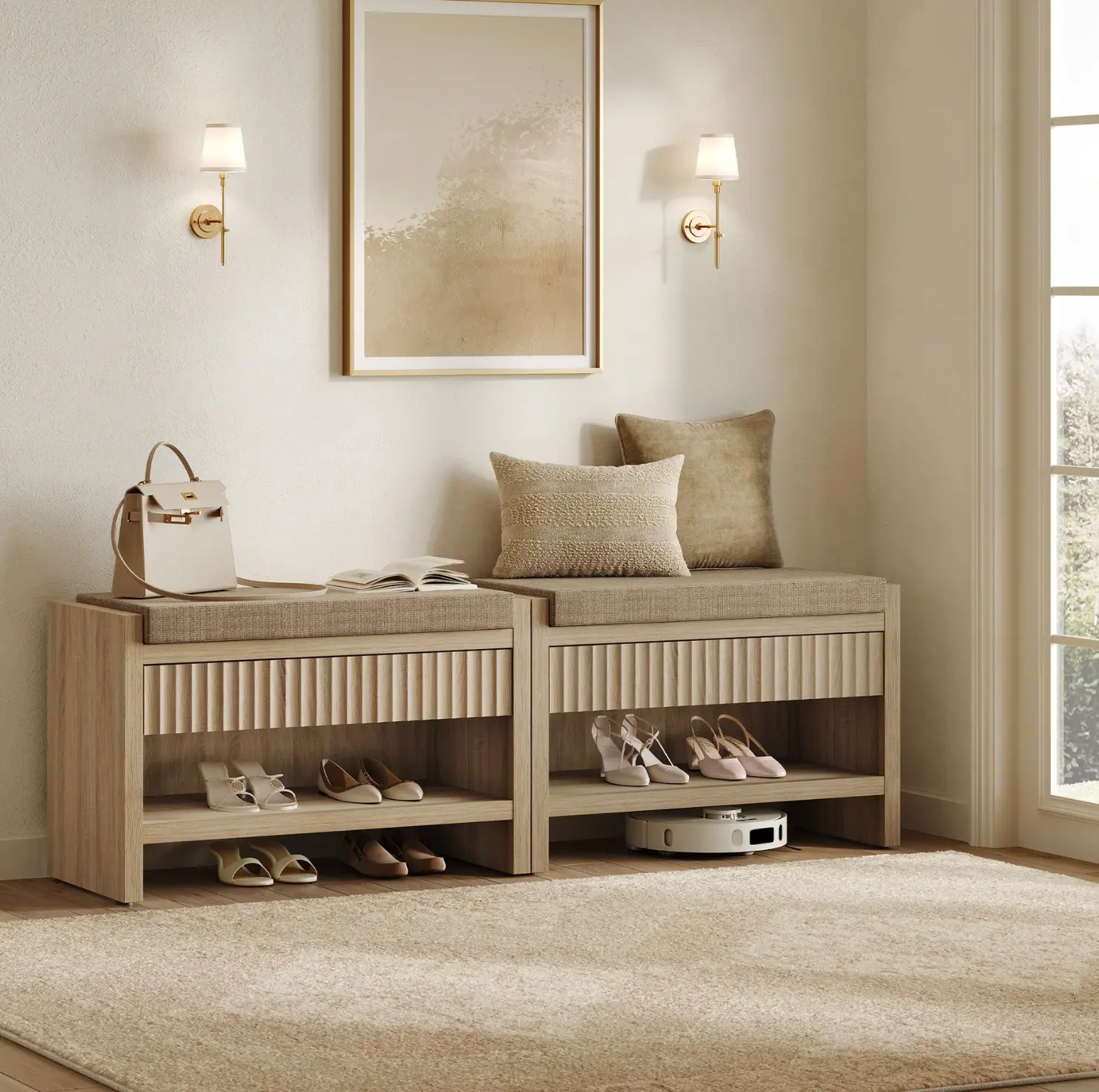
Almost everyone shops for a shoe cabinet backwards. They start with the space — “I have a narrow hallway, so I need the slimmest cabinet I can find” — and pick depth to match the wall. Then the cabinet arrives, and a pair of running shoes will not sit flat, the doors will not close over a chunky sneaker, and the boots end up back on the floor where they started.
The fix is to flip the logic. The depth of a shoe cabinet should be set first by the largest shoe you actually need to store, and only then trimmed to fit the space. A cabinet that clears the wall but cannot hold your everyday sneakers has not saved you space. It has just moved the clutter back to the floor.
Depth is decided by your biggest shoe, not your narrowest wall. Measure the shoe first, then see how slim the entryway will let you go.
That single reversal is what this guide is built on. Yes, it covers the standard depth ranges you came for, what works for sneakers versus boots, when an ultra-slim cabinet makes sense, and how flip drawers change the math. But every range is read through the same lens: not “how shallow can this cabinet be?” but “how shallow can it be while still holding the shoes I own and leaving the hallway walkable?”
Quick Answer: How Deep Should a Shoe Cabinet Be?
Most standard shoe cabinets run about 12 to 16 inches deep, which handles a lot of everyday adult footwear — flats, sandals, low-profile sneakers, and many standard shoes laid flat. Narrow tilt-out and flip-drawer cabinets can drop as shallow as 6 to 9 inches, which rescues tight hallways and apartment entries but will not swallow every shoe, especially bulky sneakers, high-tops, or boots.
| Cabinet Depth | Best For | Watch Out For |
|---|---|---|
| 6–9 in. | Very narrow halls, flats, slim shoes | Will not fit bulky sneakers or boots |
| 9–12 in. | Apartments, small entries, tilt-out designs | Check shoe angle and size |
| 12–16 in. | Standard entryway shoe cabinets | Best all-around range |
| 16–20 in. | Boots, large shoes, bench storage | Can crowd narrow spaces |
| 20+ in. | Mudrooms, large storage furniture | Usually too deep for small entries |
Underneath those ranges sit three variables that decide the right number for you: the shoes you store, the way the cabinet opens, and the walking space left once it is in place. Get those three right and the depth chooses itself. Ignore any one of them and even a “perfect-size” cabinet can fail. We will take each in turn — starting with the one nearly everyone forgets.
The Two Depths a Shoe Cabinet Has
A shoe cabinet has a depth on the label and a depth in real life, and they are rarely the same number.
The labeled number is cabinet depth: how far the body extends from the wall. The real-life number is active depth: the cabinet depth plus the room needed to swing a door, tilt a drawer, or stand in front of it to actually put shoes away. Active depth is always larger, and it is the one that decides whether a hallway still feels like a hallway after the cabinet lands.
| Measurement | What It Means | Why It Matters |
|---|---|---|
| Cabinet depth | Front-to-back furniture depth | The floor footprint |
| Door / drawer clearance | Space needed to open it | Prevents blocked access |
| Walking clearance | Space left to pass | Keeps the entry usable |
| Active depth | Cabinet depth + working space | Whether it works in real life |
A worked number makes it concrete. A cabinet listed at 12 inches deep sounds slim. But if its drawer needs 16 to 18 inches of front clearance to open fully, its active depth is closer to 30 inches. That is why a cabinet can clear the wall on paper and still choke the entryway in practice — the wall was never the real measurement. The active depth was.
A cabinet is only “small-space friendly” if its active depth — not its labeled depth — fits the entryway.
Start With the Shoe: Depth by Footwear Type
Because depth is set by the biggest shoe, the shoe chart is where this decision really begins — before any wall gets measured. Different footwear needs wildly different depth, and the largest, most awkward pair in the household is the one that sets the floor.
| Shoe Type | Storage Need | Best Depth |
|---|---|---|
| Flats / sandals | Low height, slim profile | 6–12 in. |
| Kids’ shoes | Small but often messy | 7–12 in. |
| Women’s heels | Need height more than depth | 9–14 in. |
| Standard sneakers | Moderate length and width | 12–16 in. |
| Bulky sneakers | Wider and taller | 14–18 in. |
| High-top shoes | Need height, sometimes depth | 14–18 in. |
| Ankle boots | Need height and depth | 14–20 in. |
| Tall boots | Often need vertical storage | 16–20+ in. or separate |
Do not size a cabinet for the average shoe. Size it for the largest shoe that has to live near the door — that one pair sets the minimum depth for the whole cabinet.
The practical move is simple but almost nobody does it: before shopping, go to the door, find the longest and bulkiest pair the household actually wears every day, and measure it heel to toe. A cabinet that fits flats but forces a running shoe in at an angle is not a slim solution; it is a daily annoyance that ends with shoes on the floor. The biggest shoe is the spec.
The Flip-Drawer Trick: How Angled Storage Buys Back Depth
Here is the one piece of geometry that changes the entire depth conversation, and the reason so many genuinely slim cabinets exist at all: flip-drawer and tilt-out cabinets store shoes at an angle rather than flat, so the cabinet body can be far shallower than the shoes inside it are long.
Picture the difference. On a flat shelf, a 12-inch shoe needs at least 12 inches of front-to-back room — the shelf depth must cover the whole shoe length. In a flip drawer, that same shoe tips backward at an angle, so its length runs diagonally through the cabinet instead of straight back. The exterior depth can shrink to 8 or 9 inches while still housing a shoe that would never lie flat in that space. That angle is the whole magic trick of narrow entryway storage.
| Storage Style | Depth Advantage | Best For | Limitation |
|---|---|---|---|
| Flat shelf | Most flexible storage | Mixed shoes, family use | Deeper body |
| Flip drawer / tilt-out | Shallower exterior | Narrow halls, apartments | Tight on bulky shoes |
| Open rack | Easy access | Closets, mudrooms | Shoes visible |
| Shoe bench | Seating + storage | Wider entries | Needs floor space |
A piece like the Savanna Double Flip Shoe Cabinet shows the principle at work: its double flip-drawer design tilts shoes inside, letting the cabinet sit slim against a tight hallway wall while still holding everyday footwear that a flat shelf of the same depth could never close over.
The honest trade-off: the angle that saves depth also limits flexibility. The internal tilt is tuned for typical shoes, so very chunky soles, hiking boots, or tall high-tops may not seat properly, and some flip drawers need a divider removed to take a larger pair. Flip drawers buy back depth brilliantly for everyday shoes — just not for the heaviest, tallest outliers. Match the mechanism to the footwear, not just to the wall.
[ Insert Image 2 — Feature (4:3) here. Recraft prompt at end of doc. ]
How Much Walking Clearance the Entryway Needs
Once the shoe sets the minimum depth and the opening style is chosen, the last gate is the hallway itself: a cabinet should never turn the entry into an obstacle course. The space left to walk past matters as much as the space inside.
| Entryway Situation | Recommended Approach |
|---|---|
| Very narrow hallway | 6–9 in. slim or wall-mounted storage |
| Small apartment entry | 9–12 in. flip-drawer cabinet |
| Standard foyer | 12–16 in. enclosed cabinet |
| Family entryway | Prioritize capacity, preserve the walkway |
| Mudroom | Deeper bench or cabinet acceptable |
If anyone has to turn sideways to get past it, the cabinet is too deep for that spot — no matter how well it stores shoes.
The rule of thumb is to protect a comfortable straight-through path after the cabinet is placed. When the hallway is already tight, depth wins over capacity every time: a cabinet that holds a few fewer pairs but lets people walk past normally beats one that swallows the whole household’s shoes and turns the entry into a squeeze.
Door Swing, Drawer Swing, and How the Entry Moves
Depth is not only the cabinet body — it is also how the cabinet opens, and an opening style mismatched to the space can ruin an otherwise well-sized piece.
| Opening Style | Space Needed | Best For |
|---|---|---|
| Open shelf | No door swing | Closets, mudrooms |
| Hinged doors | Front clearance needed | Wider foyers |
| Sliding doors | Less front clearance | Narrow entries, if available |
| Flip drawers | Moderate front movement | Small apartments |
| Pull-out drawers | More front clearance | Larger entryways |
| Bench lid | Top access | Mudrooms, wider spaces |
Before buying, check how the cabinet will open against everything that moves nearby: the front door swing, the closet door, any hallway door, the entry rug, and the space for a person to stand while opening it. In the tightest entries, a flip-drawer or sliding-door cabinet earns its keep precisely because it needs less front clearance than a hinged-door or pull-out design. The best depth is always the one that works with the way the entry actually moves.
How to Measure Your Entryway, Step by Step
Here is the full method, in the order that prevents regret. Ten minutes and a roll of painter’s tape settle the decision before any money changes hands.
- Measure the shoe first. Find the longest, widest, tallest pair that must live by the door and measure it. This sets your minimum depth before anything else.
- Measure the narrowest point of the entry — not the widest wall. The tight spot near a door swing, a stair, or a hallway turn is what truly limits depth.
- Tape the depths. Mark 7, 10, 12, and 16 inches out from the wall in painter’s tape.
- Walk the test. Pass the taped zone carrying a bag, a laundry basket, or a backpack. If you turn sideways, that depth is too much.
- Check every door swing. Front door, closet door, any nearby interior door.
- Add opening clearance. Account for hinged doors, pull-out, or flip-drawer movement — this is the active-depth step.
- Pressure-test daily use. Will kids, pets, guests, and several people at once all manage it on a busy morning?
Entryway fit depth = cabinet depth + opening clearance + walking comfort. Tape all three on the floor, not just the cabinet footprint.
How Many Pairs a Narrow Cabinet Really Holds
Pair-count claims are useful for comparison and unreliable as a promise, because the number always assumes a certain kind of shoe. The same cabinet holds far more flats than boots.
| Claimed Capacity | Realistic Use Consideration |
|---|---|
| 8–12 pairs | Good for singles, couples, or small entries |
| 12–18 pairs | Useful for apartments or daily shoes |
| 18–24 pairs | Better for families or mixed use |
| 24+ pairs | Check shoe size, depth, shelf layout, and height |
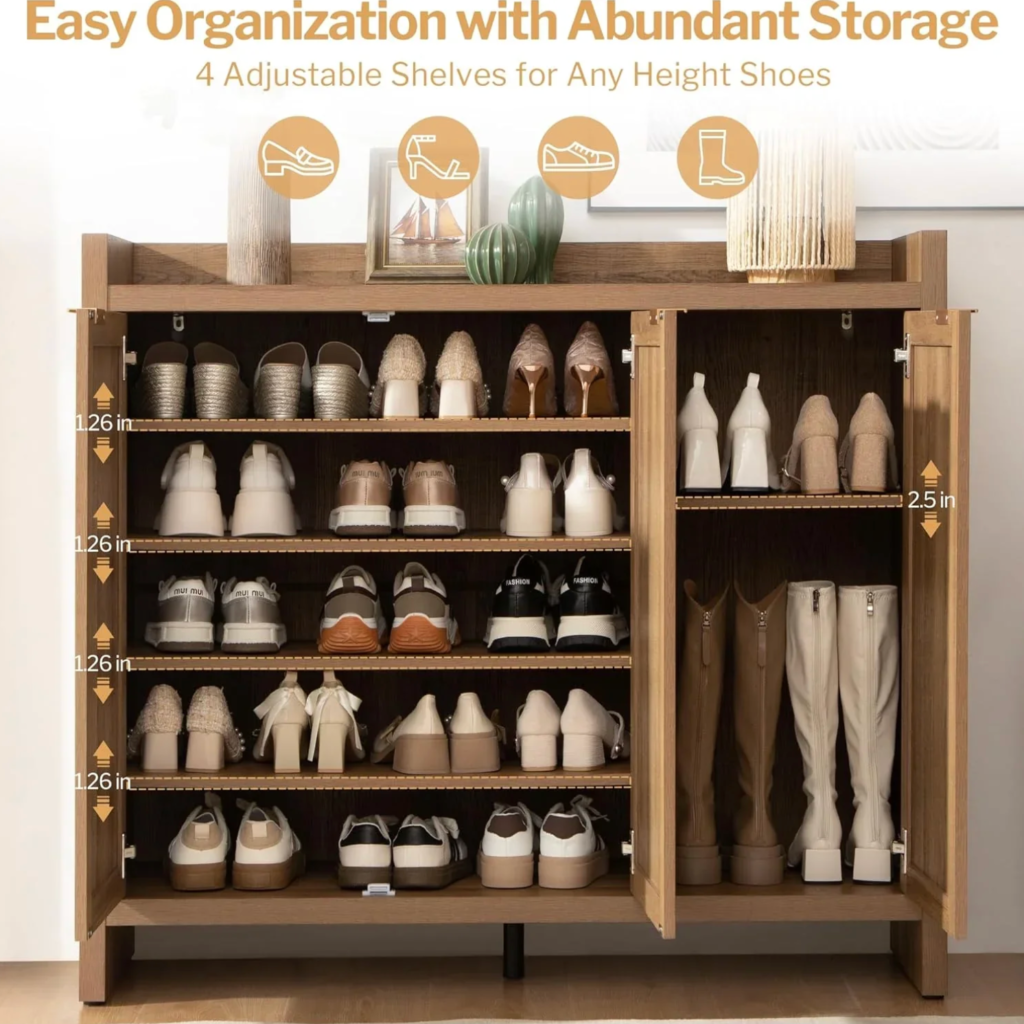
A cabinet such as the Prelude Shoe Cabinet, rated up to 24 pairs, can be a real help for households that want daily footwear hidden by the door — but the same caution applies: that 24 assumes average shoes, so compare the cabinet depth, your largest pair, and the entry clearance before trusting the headline number.
A sharper question than “how many pairs does it hold?” is “how many of my daily shoes will actually fit comfortably?” Count only the pairs that genuinely need to live at the door, send seasonal and occasional shoes to a closet, and size for the real daily number rather than the marketing maximum.
When a Narrow Shoe Cabinet Is the Right Call
A slim cabinet is not a compromise in every entry — sometimes it is exactly the correct tool. It tends to be the best choice when the entry is small, when shoes are creating visible clutter, when the hallway cannot carry a deep bench, when the front door opens right beside the storage spot, when a closed look beats an open rack, and when the space simply needs to stay visually calm — a common reality in rentals and apartment hallways.
For tight apartments, foyers, or narrow hallways, narrow shoe cabinets can deliver hidden storage without forcing the entry to become a full mudroom — provided the depth still clears the shoes inside.
The Two Failure Modes: Too Shallow and Too Deep
Signs the cabinet is too shallow
A shallow cabinet looks like a space-saving win until the shoes refuse to cooperate. Watch for the tells: sneakers have to be forced in, shoes sit at a strange angle, doors will not close smoothly, high-tops and heels do not fit, pairs have to be stacked awkwardly, and the cabinet only really works for a couple of shoe types. The decisive sign is behavioral — family members quietly stop using it. The moment storage feels like a puzzle, the shoes go back on the floor and the cabinet has failed at its one job.
Signs the cabinet is too deep
A deep cabinet fails in the opposite direction. It holds plenty, but it blocks the room: people turn sideways to pass, the front or closet door bumps it, the entry feels visually heavy, and the broad top quietly becomes a dumping ground for mail, keys, and bags — so the shoes are hidden but the entry still reads as cluttered. In a small entryway, the verdict is consistent: a slightly smaller cabinet that gets used every day beats a larger one that makes the space awkward.
Best Depth by Entryway Type
Pulling it together, depth strategy shifts with the kind of entry you are working with:
| Entryway Type | Depth Direction | Why |
|---|---|---|
| Studio apartment | 6–10 in. | Protects walking space |
| Narrow hallway | 6–9 in. | Minimizes obstruction |
| Small foyer | 9–12 in. | Balances storage and space |
| Standard entryway | 12–16 in. | Fits more everyday shoes |
| Family entryway | 12–18 in. | More capacity if space allows |
| Mudroom | 16–20 in. | Can support bench or boots |
| Door opens to living room | 9–14 in. closed | Keeps shoes visually hidden |
There is no universal best depth — only the right match of shoe size, opening style, and walkway for your particular entry. Browsing the Sicotas entryway range across slim flip-drawer, standard enclosed, and bench formats is an easy way to see how the same footprint can be engineered to very different depths, so you can match the cabinet to the entry you actually have.
Safety and Stability for Slim Cabinets
Slim shoe cabinets are often tall as well as shallow, which makes stability a real consideration rather than a formality. Follow the manufacturer’s assembly instructions, use the anti-tip hardware when it is provided — especially in homes with children or pets — and keep heavier shoes in the lower compartments. Do not let children climb or hang on the drawers, secure wall-mounted or very shallow cabinets properly, keep the piece on level flooring, and resist overloading the top surface. Small-space furniture still has to feel solid in daily use.
The Entryway Shoe Cabinet Checklist
Before you buy, confirm all sixteen. If the last one is a “no,” it is the wrong cabinet:
- Hallway width (narrowest point) · Cabinet depth · Active depth
- Front door swing · Closet door swing · Drawer or flip-drawer movement
- Walking clearance · Longest shoe length · Tallest shoe height
- Number of daily pairs · Boot storage needs · Family member access
- Wall anchoring needs · Package size · Delivery path
- Whether it will still feel easy to use every single day
Final Takeaway: Depth Follows the Shoe, Then the Space
The best shoe cabinet depth is not the shallowest one on the page. It is the depth that holds the shoes you actually wear, opens cleanly in the space you actually have, and leaves the entry comfortable to walk through. For a tight apartment, that may be an ultra-slim flip-drawer cabinet whose angled drawers buy back the depth the wall cannot spare. For a family home, it may be a deeper enclosed cabinet with the capacity to match.
Either way, the order is what matters. Measure the shoe first, then the narrowest point of the entry, then the door swings and the walkway. Choose the depth that satisfies all three — not the smallest number that clears the wall.
A shoe cabinet should take clutter out of the entryway — not become the new obstacle everyone has to squeeze past.
Also Read

Add a Comment