
Rattling floors and ceilings are not always caused by loud airborne noise. In many cases, the problem starts as vibration. When impact sound from footsteps, dropped objects or chair movement enters the structure, it can travel through floors, ceilings, walls and fixings until a surface or fitting begins to shake.
Mechanical vibration can create the same effect. Pumps, HVAC equipment, appliances, speakers or machinery may send energy through connected building elements, making the visible rattle appear far from the original source. Solving the problem starts with finding where the vibration begins and how it travels, not only covering the surface where the noise is heard.
Rattling Is Usually a Vibration Problem, Not Just a Noise Problem
Rattling is sound created by movement. When part of a floor, ceiling, fitting or building element starts to shake, even slightly, that movement can become audible as buzzing, tapping, clicking or vibration noise.
This often happens when energy enters the structure. Footsteps from above, a washing machine during a spin cycle, HVAC equipment, speakers, subwoofers, pipes, pumps, doors, lifts or machinery can all send vibration into floors, ceilings, walls or connected fixings. Once that vibration reaches a loose or lightweight element, the rattle becomes easier to hear.
The source is not always in the same place as the sound. A ceiling panel may rattle in one room, while the vibration begins from equipment in another. A floor may buzz because of a pipe, pump or machine connected elsewhere in the building.
This is why rattling floors and ceilings should not be treated only as surface noise. The visible surface may be where the sound appears, but the real problem often starts with vibration travelling through the structure.
How Impact Sound Travels Through Floors and Ceilings
Impact sound starts when something makes direct contact with a surface. Footsteps, dropped objects, chair movement or heavy items placed on the floor do not only create noise in the room where they happen. They also send force into the floor structure itself.
Once that energy enters the floor, it can travel through the slab, beams, joists, ceiling below and connected building elements. The person below may not hear only the original step or object. They may hear the ceiling vibrate, a fitting buzz or a panel rattle as the structure carries the impact into another space.
Hard floor finishes can make this effect stronger when the construction beneath them is poorly isolated. Tile, stone, timber or laminate can transfer impact more directly if there is no suitable acoustic layer, resilient separation or properly detailed floor build-up.
The problem is therefore not only what people hear in the room above. It is what the building structure carries from one space to another.
Floors Can Rattle When the Build-Up Is Poorly Isolated
Floor construction plays a major role in how vibration moves through a building. When the visible floor finish, structural layer and ceiling below are too rigidly connected, impact energy can travel easily from one space to another and make connected elements rattle.
Common causes include:
- Hard finishes installed over rigid structures, such as tile, stone, timber or laminate placed without enough acoustic separation;
- Missing or poor acoustic underlay, which allows footsteps, chair movement and dropped objects to transfer more directly into the floor;
- Weak floating floor detailing, where the system is not properly isolated from the structure below;
- Gaps or contact points at the perimeter, where the floor touches walls or skirting and creates a rigid bridge for vibration;
- Lightweight floor systems, which can respond more noticeably to impact when they are not properly supported or isolated.
Adding a rug can soften surface impact and make footsteps less sharp inside the room. It can help, but it does not fully solve structural vibration if the floor build-up underneath is poorly isolated.
Ceilings Can Amplify Noise From Above
Ceilings are often the first surface people blame when they hear rattling from above. The sound may seem to come directly from the ceiling, but the real source can be footsteps, equipment, pipes or vibration entering the structure elsewhere.
Suspended ceilings, plasterboard ceilings and service voids can all reveal vibration from the floor above. A ceiling cavity may carry sound through the void, while light fittings, access panels, metal grids or poorly secured boards can begin to buzz or rattle when vibration reaches them.
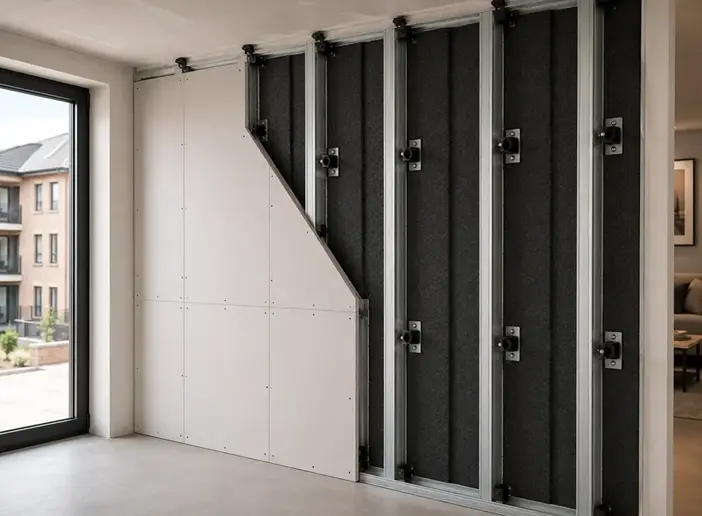
A ceiling system that is not properly isolated may therefore make the problem more noticeable instead of reducing it. If it is too rigidly connected to the structure above, it can transmit vibration. If loose elements sit within the ceiling, they can turn that vibration into audible noise.
Effective ceiling treatment must match the source and the vibration path. Treating the visible ceiling alone may not work if the energy is coming through the floor above, the walls, pipework or mechanical systems.
Soundproofing Must Target the Path, Not Only the Surface
Covering a ceiling may not solve a rattling problem if vibration is travelling through walls, pipework, service routes or connected structural elements. The visible surface is often only where the noise appears. Effective soundproofing needs to follow the path that vibration takes through the building.
A useful approach looks at three points:
- Source control, such as isolating a machine, pump, speaker or appliance before vibration enters the structure;
- Path interruption, such as improving floor impact insulation, adding resilient layers or reducing rigid connections between building elements;
- Receiver-side treatment, such as decoupling a ceiling, securing loose panels or treating the room where the rattle is heard.
The right solution depends on where the vibration begins and how it travels. A machine may need isolation mounts. A floor may need better impact insulation. A ceiling may need decoupling rather than another layer fixed directly to the same structure. Loose fittings, panels and pipework may also need to be sealed, tightened or separated so they cannot turn vibration into audible rattling.
Effective soundproofing is not just about adding material to the surface that makes noise. It is about finding the vibration path and treating the weak point that allows the sound to travel.
When Professional Acoustic Assessment Is Needed
A simple inspection can sometimes identify a loose panel, unstable appliance or visible gap. However, DIY checks may not be enough when the source of the rattle is unclear or when vibration travels through several connected parts of the building.
Professional acoustic assessment is useful when:
- The source of the vibration cannot be easily located;
- The rattle affects several rooms or floors;
- Machinery, HVAC systems, pumps or other building services are involved;
- Complaints come from neighbours or adjoining spaces;
- Renovation, construction or equipment installation is planned;
- Previous fixes have not solved the problem.
Acoustic specialists can identify how structure-borne noise moves through floors, ceilings, walls, pipework and mechanical connections. They can then recommend suitable soundproofing measures or vibration isolation solutions, such as isolating machinery, treating rigid connections, improving floor or ceiling systems and securing elements that turn vibration into audible rattling.
The value of assessment is precision. Instead of adding material where the noise is heard, it helps locate where the vibration starts, how it travels and which detail needs to be corrected.
Stop the Vibration Before It Becomes a Rattle
Rattling floors and ceilings are usually symptoms, not the root cause. The sound may come from a ceiling panel, light fitting, loose floorboard or pipe, but the hidden issue is often vibration moving through the building structure.
That vibration may begin with footsteps, machinery, appliances, speakers, pumps or building services. Once it reaches a weak or loose element, the movement becomes audible as buzzing, tapping or rattling.
The best solution is not simply to cover the surface where the noise appears. It is to find where the vibration starts, how it travels and which detail allows it to become sound. When the path is understood, the rattle can be treated at its real source rather than hidden temporarily.
Also Read-Best Portable Power Stations for Home Backup Power

Add a Comment