There’s a question a lot of aspiring game creators skip past: what are you actually trying to accomplish right now? If the honest answer is “I want to know whether this idea is fun,” reaching straight for a traditional engine is often the wrong first move. Engines are built for production, for teams that already know what they’re building and need deep control over every system. Testing a raw idea is a different job, and treating it like a production task is one of the most common reasons promising concepts stall before they’re ever finished.
The Case for Starting Somewhere Simpler
Most abandoned game projects don’t die because the idea was bad. They die because the setup cost of testing the idea was so high that motivation ran out before there was anything playable to react to. If you’re not yet sure a concept works, the smartest move is often to spend as little technical effort as possible confirming that before committing to a full production pipeline.
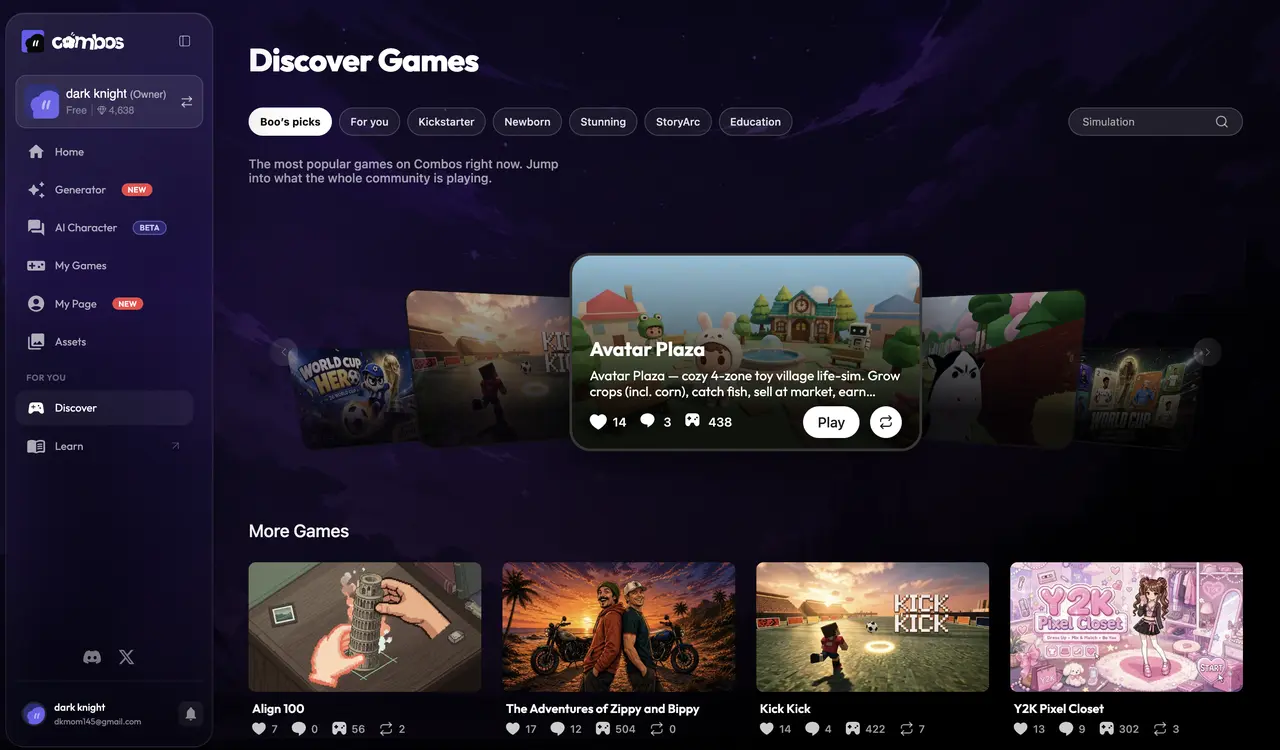
This is precisely the use case for an AI video game maker like Combos. Instead of opening an engine and building systems from scratch, you describe your concept in plain language and get back a structured Game Design Document along with a playable prototype: levels, characters, and mechanics already generated and integrated. If the idea turns out to be fun, you’ve lost nothing by testing it this way first. If it doesn’t land, you’ve lost an afternoon instead of a month.
Where Vibe Coding Fits Into That Decision
The approach now widely known as vibe coding, describing what you want by feel and letting AI generate a working version, is really a tool for exactly this early stage. It’s not meant to replace deep technical development. It’s meant to answer the question of whether deep technical development is even worth starting.
A vibe coding game on Combos starts from a description of the mood and gameplay style you’re after, using either a genre template or a fully custom prompt, and produces logic, assets, and a working prototype automatically. From there you refine it in a no-code visual editor. If your concept survives that early testing and you decide it deserves a full production build in a traditional engine later, you haven’t wasted the exploration time, you’ve used it to make a much better informed decision about where to invest real production effort.
When a Traditional Engine Still Makes Sense
To be fair to traditional engines, they still matter a great deal, and there’s no honest version of this comparison that pretends otherwise. Large scale, technically demanding titles with custom systems, tight performance requirements, or complex multiplayer architecture generally need the deep control a full engine provides. A studio shipping a AAA title isn’t choosing between an engine and an AI tool, they’re using an engine because the project genuinely requires it.
The distinction that actually matters is what stage of the process you’re in and what kind of question you’re trying to answer. Early stage, idea validation, and rapid iteration questions are well served by AI assisted tools. Long term, technically demanding production questions still belong to traditional engines.
The Risk of Skipping This Stage Entirely
Plenty of teams skip early validation altogether and jump straight into full production, usually because setting up a proper prototype felt like almost as much work as just starting the real build. That instinct is understandable but often expensive, since problems that would have surfaced in a rough prototype instead surface months later, after a much larger investment has already gone into a direction that turns out not to work. A cheap, fast validation stage isn’t just a nice extra step, it’s protection against the much larger cost of discovering a fundamental problem late.
A Practical Way to Decide
A useful test: if you’re not yet sure your idea is fun, start with the faster, lower cost option. If you already know it’s fun and the remaining work is technical execution at scale, that’s when a traditional engine earns its overhead.
What This Looks Like in Practice
Picture two creators with the same concept for a puzzle game. One opens a traditional engine and spends two weeks building a basic version before finding out whether the core puzzle mechanic is actually satisfying to solve repeatedly. The other describes the concept in plain language, has a playable version within a day, and spends that same two week window testing five variations of the puzzle mechanic with real players. By the time both reach a decision point, the second creator has far more evidence to work from, and that evidence came at a fraction of the cost.
The Real Advantage Isn’t Speed, It’s Better Decisions
The actual value of tools like this isn’t just that they’re faster, though they are. It’s that they change when in the process you have to commit to a direction. Traditional development forces an early commitment, because setup costs are high enough that you can’t afford to test many alternatives. AI assisted prototyping lets that commitment come later, after you’ve actually played several versions of an idea rather than only imagined them.
That’s a meaningfully better way to make creative decisions, regardless of whether the final version of your game ends up built with AI assistance or in a full production engine down the line.
Also READ-Tech Leader Onboarding Checklist for High-Growth Companies

Add a Comment