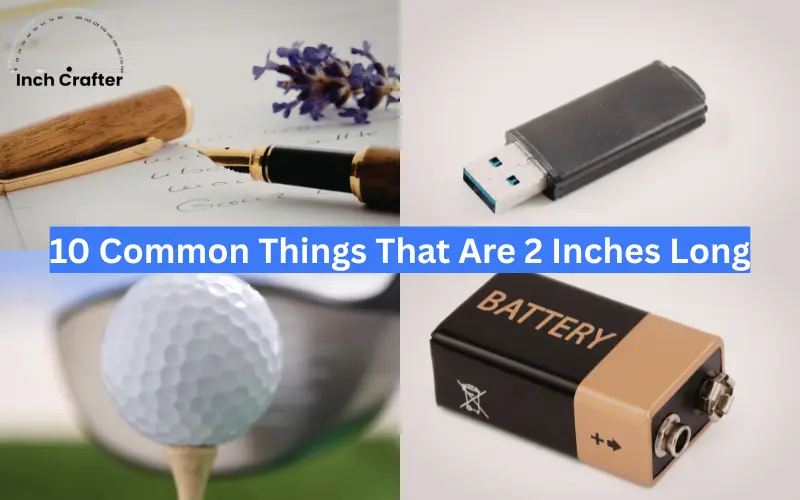
How long is 2 inches? 2 inches is equal to 5.08 centimeters or 50.8 millimeters. While it may seem like a very small measurement, 2 inches appears in many everyday objects, tools, and product sizes. From small hardware items to phone accessories and household objects, this measurement is surprisingly common.
Understanding how long 2 inches is becomes much easier when you compare it with familiar items around you. Whether you’re checking product sizes online, working on a small DIY project, or simply trying to visualize a measurement, real-world comparisons can make this tiny length much easier to imagine.
1. AA Battery

The standard AA battery is the gold standard for estimating 2 inches. From positive tip to negative base, a fresh alkaline AA measures 50.5 mm—only 0.3 mm shorter than exactly 2 inches. This size has been standardized since the early 20th century and is the same for Duracell, Energizer, Panasonic, Amazon Basics, and store brands worldwide.
Because they are perfectly cylindrical and produced in the billions each year, AA batteries are used by carpenters, nurses, photographers, and parents as an instant measuring reference. They fit neatly in the hand and roll straight, making them ideal for checking gaps, depths, or lengths when a ruler isn’t available.
2. Two U.S. Quarters Side by Side

The United States quarter dollar has a diameter of exactly 24.26 mm (0.955 inches). Lay two quarters edge-to-edge and the total length is 1.91 inches—less than 2.3 mm short of perfect. This tiny difference is invisible to the eye in most practical situations.
Quarters are especially handy because they are thick enough to stand on edge, lie flat without wobbling, and are carried by millions of people every day. Mechanics use them to check brake-pad thickness, teachers use them for quick math lessons, and crafters use them to space buttons or hooks exactly 2 inches apart.
3. Short Side of a Credit or Debit Card

Every major credit card, debit card, gift card, hotel key, and driver’s license follows the ISO/IEC 7810 ID-1 standard: 85.60 mm × 53.98 mm. The shorter edge is 2.125 inches (54 mm), only 3.2 mm longer than 2 inches. The corners are precisely radiused, the material is stiff, and the size never changes—making cards one of the most consistent references available.
Travelers use the short side to judge whether luggage wheels or laptop chargers will fit in tight airplane pockets. Photographers use them to frame passport photos, and parents use them to measure medicine cup markings when a syringe is missing.
4. Classic Bic Cristal Pen Cap

The iconic Bic Cristal—the world’s best-selling pen—has a removable cap that measures 50–51 mm depending on the year and factory. That puts it within a fraction of a millimeter of exactly 2 inches. The cap is straight, lightweight, and has a handy pocket clip, so it’s easy to pull off and lay flat for measurement.
With over 100 billion Bic pens sold since 1950, this simple blue, black, or red cap is found in classrooms, offices, courtrooms, and kitchens on every continent (even Antarctica research stations keep them in stock). Students have used Bic caps for decades to draw perfect circles or space lines on notebook paper.
5. Standard House Key (Yale, Kwikset, Schlage)

Most residential door keys in North America measure 2.0 to 2.2 inches from the top of the bow (the part you hold) to the tip of the blade. Popular key blanks such as KW1, SC1, WR5, and Y1 are all designed around this length for comfort and to fit standard lock cylinders. Because the bow shapes are generous, the straight portion of the key blade alone is often very close to exactly 2 inches.
Locksmiths, real-estate agents, and homeowners unconsciously carry this precise reference every day. Many people discover the accuracy only when they need to measure a screw length or cabinet depth and realize their front-door key is the perfect tool.
6. Standard Golf Tee

The overwhelming majority of golf tees sold in pro shops, sporting-goods stores, and online are 2⅛ inches (54 mm) long. This length has been the unofficial standard for decades because it places the ball at the ideal height for drivers and fairway woods. Both wooden and plastic versions are manufactured to tight tolerances, so a tee taken from any new box will be within a millimeter of the same length.
Golfers often keep a handful in their pockets, making the tee a surprisingly common 2-inch reference even for non-golfers who find one in the car or laundry. Groundskeepers and landscapers also borrow tees to mark sprinkler-head depths or planting distances.
7. USB-A Connector Metal Section

The metal shield of a full-size USB-A plug—the rectangular part that slides into a computer or charger—measures approximately 47–50 mm in exposed length on most cables and flash drives. When you include the slight plastic overhang that stops insertion, many reach exactly 2 inches tip-to-overhang.
With USB-A still the most common connector on chargers, keyboards, printers, and power banks, this familiar silver rectangle has become an accidental global standard. IT professionals, students, and travelers routinely use a spare USB cable to judge whether a new device will clear a desk edge or fit inside a laptop bag pocket.
8. Large Chicken Egg (Measured Lengthwise)

USDA “large” eggs must weigh 24–27 ounces per dozen, which produces an average length of 2.2 to 2.35 inches along the long axis. While not exact, the variation is small enough that cooks and bakers worldwide treat a large egg as a reliable 2¼-inch reference.
Eggs are especially useful in the kitchen when cutting dough, vegetables, or meat into roughly 2-inch pieces—no ruler needed. Farmers’ market shoppers use an egg to estimate whether a new frying pan is deep enough, and parents use one to show children how big 2 inches really is during science lessons.
9. Classic Rectangular Matchbox

Traditional safety-match boxes (the type with a striking surface on the side) have remained almost unchanged for over a century. The outer box typically measures 50–51 mm long, 35–38 mm wide, and 12–15 mm tall. Brands such as Diamond Greenlight, Swan Vestas, Ohio Blue Tip, and Eddy matches all follow this near-identical sizing.
Because matchboxes are rigid cardboard and produced in the hundreds of millions each year, they offer a pocket-sized 2-inch standard that fits easily in a kitchen drawer, camping kit, or workshop. Woodworkers and model-makers often use an empty matchbox to space dowels or mark cut lines.
10. ChapStick or Standard Lip Balm Tube

The original ChapStick tube, along with Burt’s Bees, Carmex, and most generic drugstore lip balms, stands exactly 2 inches (50.8 mm) from base to the top of the cap when closed. The design has been essentially unchanged since the 1970s, ensuring remarkable consistency across brands and decades.
These little cylinders are carried in purses, pockets, backpacks, desk drawers, and car consoles by hundreds of millions of people worldwide. Their perfectly round shape and precise length make them ideal for checking hole diameters, dowel sizes, or even whether a new watch will clear a jacket cuff.
You may also like these too:
- How Long is 3 Inches
- How Long is 4 Inches
- How Long is 5 Inches
- How Long is 6 Inches
- How Long is 7 Inches
FAQs
How long is 2 inches in centimeters?
2 inches is equal to 5.08 centimeters. This is a small but noticeable length that appears in many everyday objects and tools.
What objects are about 2 inches long?
Many small items are close to 2 inches, such as an AA battery, a golf tee, or the width of two standard coins placed together.
Is 2 inches a big measurement?
No, 2 inches is considered a small length. However, it is still large enough to see clearly and is common in small hardware, electronics, and accessories.
How can I measure 2 inches without a ruler?
You can estimate 2 inches by comparing it with common items like an AA battery or other small objects that are around this length.
How many millimeters is 2 inches?
2 inches equals 50.8 millimeters, which is another standard way of expressing this measurement in the metric system.
Why are inches still used for measurements?
Inches are widely used in the United States and many industries like construction, electronics, and manufacturing, even in countries that use the metric system.
Conclusion
Even though 2 inches seems like a very small measurement, it appears more often in daily life than most people realize. From batteries and small gadgets to household tools and accessories, many common items are designed close to this size.
Using familiar objects as references makes it much easier to understand how long 2 inches is without needing a ruler every time. Once you start noticing these small comparisons, visualizing measurements becomes much quicker and more practical.
Over time, these simple references help you estimate sizes more accurately when shopping online, doing DIY projects, or comparing product dimensions. A tiny measurement like 2 inches can actually be very useful when you know what to compare it with.

Add a Comment